Showing posts with label fragrance families. Show all posts

Thursday, October 29, 2015

Palette Exploration: Chypre Perfumes


Tonight from 6:30 to 8:30 at the perfumery we are going to delve into the botanical essences used to create a Chypre style perfume. This fragrance classification was introduced in the 19th century but made popular in 1917 by François Coty with the release of Coty's ‘Chypre’ and Guerlain with . The French word comes from Cyprus in the Mediterranean

At the heart of the chypre structure is the contrast between the sweet, fresh notes of an unripe Italian citrus called bergamot and the rich, heavy note of oakmoss. These two pivotal ingredients are built upon with woody, floral and animalic notes.

The two most typical chypre fragrances in my line are GreenWitch and Gracing the Dawn.

October 29, 6:30 - 8:30; Chypre Perfumes
November 5, 6:30 - 8:30; Oriental Perfumes

If you choose to attend please purchase your seat in advance to be guaranteed a space.

Painting by Rodolphe Ernst

Friday, March 26, 2010

Perfume Illuminated: Raspberry


The fruit trees last week were in full bloom here in the City of Angels. I witnessed it on a stroll, regrettably without a camera, just when the blossoms were in flower without any leaves. Such a glorious site. These fruit trees will soon dislay their fresh green cloak for the new season adorned with tiny round balls turning into fresh fruit. What an abundant time of the year, no wonder the birds are singing with such vigor and delight!

Among the fruits soon to be appearing first, if not already, are those from the berry tribe. Raspberry is the illuminated celebrity fragrance and flavor focus for today.


FRAGRANCE

The fragrance of raspberry is within the "fruity" category of the descriptive language used in perfumery. This very popular scent family is defined by the aroma of fresh fruit, it generally depicts a sense of fresh youthfulness and is popular as the months grow warmer.


The palette of the botanical perfumer has no raspberry essence. No one, as of yet, has captured the aroma of raspberry as an essential oil or absolute. Raspberry, Rubus idaeus, does exist as a cold pressed seed oil that can be utilized for lip balms and skin preparations. Raspberry seed oil is packed with essential fatty acids and vitamins. Excellent for use on the skin with a subtle aroma of raspberries.

For the creative and adventurous types I suggest getting some dried raspberry fruit at the market and tincturing it in grape alcohol. This will produce a red raspberry tincture that can then be added to other fruity notes to create the impression of Raspberry for a botanical perfume.


FLAVOR: Beth Schreibman Gehring
Please continue reading about Raspberry at the Windesphere Witch blog

Monday, January 4, 2010

As Noted


I often get asked to "reveal" more of the notes in my perfumes. When this query is presented I wonder what exactly is being asked. For example is it the fragrance notes or the ingredients that the enquirer is interested in? If it is the fragrance notes then I ask them, "Well, what fragrance notes are you perceiving?" After all, perception is an act of creation. Each persons perception will be different based on their life experience. Who am "I" to tell "you" what to smell?


I use accords/chords in perfumery formulation. These have been created in advance. Each accord has at least six different ingredients. Some accords have several accords within them, my Leather accord is the most complex containing about three accords within that one accord. Perfumers, like artists, have different modes of working. Some perfumes have simple formulas with three top notes, three middle notes and three base notes. This is the system that Mandy Aftel taught back in April of 2002 when she was here at my home facilitating a Natural Perfumery Workshop to a small group. Even further back when I studied with John Steele he had us creating perfumes with a few simple notes including a methodology similar to the top, middle and base approach.
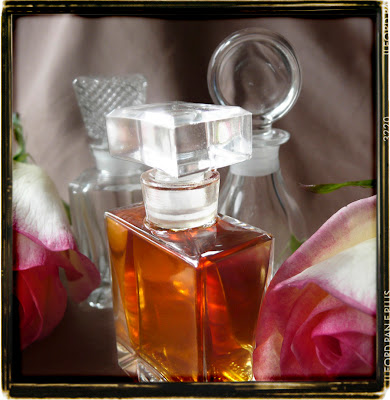


The formulas in my perfumes are extremely complex. Rosa liquid perfume has four different accords contained within her, Sierra liquid also has many accords. Even Sierra Solid Gold has a few of the same multiple accords as her liquid counterpart as well as an infused oil accord made with the intention of prosperity. Each Illuminated Perfume has at the very least one accord.

For the materials used I prefer to state what is contained, compared to what is not. However, traditional thought processes still seem to want the not. Thus...lets begin with what is used in Integral Perfume:
  • Organic Grape Spirits and Organic Grain Alcohol distilled in Oregon, both beverage grade.
  • Essential Oils, Absolutes, Concretes and C02 extracts primarily from plant matter. The only essences that are not from plants are: Beeswax, Honey, Seashells and Seaweed. GreenWitch contains a very small amount of Africa Stone, which is the fossilized excrement of a small mammal in Africa. I utilize "whole" essences in keeping with the concept of Gaia and Holistic Aromatherapy.
  • Golden Jojoba Seed Oil.
  • Organic, unfiltered Beeswax, from local sources including bees I am tending.
  • Plant infusions and tinctures, some from my own native plants.
What I do not use:
  • No animal ingredients (except for a tad of Africa stone), nor do I test on animals.
  • No isolates, as stated above I only use "whole" essence.
  • No synthetic fragrances.
  • No petrochemicals.
  • No parabens.
  • No phthalates.
  • No artificial colors.
A definition of what botanical perfume is can be read here at this journal by following this link: Botanical Perfume: A Comprehensive Definition.

Then there is this asking of well which ingredients exactly? When I list woods the most common in my palette are Cypress, Cedarwood and Sandalwood. I have a vintage Mysore Sandalwood, Santalum album, from an old growth tree that due to age fell down. I also have some of the distillations from other parts of the world. With Cedarwood or Cypress there are many different types of each and depending on the botanical name, where the plant material originates and is distilled there will be variations in the aromatic profile. For example with Cypress you have the standard as well as an emerald, a jade, a blue and an absolute, each will impart different "notes" to the perfume. So then the question becomes, well which one exactly. That answer gets into propriety information and I will not venture into that territory. My Wood accord has a variety of each of the ones listed above as well as other woods. This can be even more complex if you take into account that there are some woods that do not have a distinctive "woody" note to them.


Some of my accords are vertical, some horizontal and some can be considered complete perfumes onto themselves. This was noted by Andy Tauer when he was here at the studio last year. I had him sniff several of my Floral accords which made him comment that some were perfumes onto themselves and that Vero Kern works in a similar manner. Andy uses the term bases for what I call accords/chords, where as a base for me can mean the carrier as an oil or alcohol or a base note.

There are instances where an infusion, tincture or wax is utilized this imparting a note that is not from the essential oils, absolutes, c02 extracts or concretes.

Now you are wondering how this question became so complicated when you just wanted a simple answer. Regrettably, as you can see the answer is not simple unless you look at my very early formulas when I was taking the leap from Aromatherapy into Natural Perfume. Here is an example of a simple formula I made in the 1990's at a class in Malibu with John Steele: Spikenard, Patchouli, Vanilla, Jasmine, Elemi, Nutmeg and Grapefruit.

Vespertina™ liquid perfume is a good example of how there is a specific fragrance note that is not an ingredient. Although there is no Orange Blossom in the perfume it is repeatedly cited as the main fragrance note. In fact, just recently on the Fragranticia blog, Michelyn Camen stated "Roxana Villa’s intoxicating orange blossom and floral Vespertina perfume..."

To list every single ingredient in each of my perfumes would be daunting and provide no meaningful information. The more important questions are: Do you like the fragrance? How does it make you feel? What memories are being stirred for you? Keep in mind that the perfumes I formulate are created from whole, vital plant essences used in therapeutic aromatherapy. So the question of "How does it make you feel?" is very relevant.

The big main stream perfume houses decided to use synthetic aroma chemicals created in a lab so that they need not deal with the variety and the dynamic shifts in nature. To supply aromas to the masses for the multitude of fragrance products the synthetic route was chosen since it is predicable and allows for a much larger profit margin. Generally when you see the words Rose and Jasmine in most perfumes it is an aroma chemical that is attempting to recreate the aroma of the essential oil or absolute, some of the most expensive raw materials in perfume.


Getting back on track here with authenticity and the notes in my perfumes I have created a list to make things a bit easier for those craving more in depth notations into each of my perfumes. Indeed, I do not reveal all my actual ingredients. It's the mind that wants the list of ingredients, it's the heart and soul that devours the fragrance. I invite you to let go of the mind and journey to that sensuous and vibrant Garden of Eden.

Roxana Illuminated LIQUID Perfumes
in a base of beverage grade, organic grain and grape alcohol.


Lyra
Fragrance family: FLORAL, ORIENTAL
Twenty different essences including: Amber Accord, Jasmine, Ylang Ylang and Citrus.
Review of Lyra Liquid at The Pink Room

Aurora
Fragrance family: FLORAL, ORIENTAL
Amber Accord, Jasmine, Rose, Spice and Mandarin.
Read Divina's review at the Fragrance Bouquet here.

Q
Fragrance family: WOOD, CHYPRE
Resin, Wood Accord, Italian Bergamot, tinctured Coastal Live Oak leaves
More info about Q here at the journal
Reviews of Q perfume
Article from the Topanga Messenger: The Oaky Scent of Philanthropy
Q is featured at the Examiner.com - USA
A portion of the proceeds from the 7 gram flacon supports the California Oak Foundation.

Chaparral®
Fragrance family: WOOD, INCENSE
Frankincense, Wood Accord, Sage, Bay.
A percentage of proceeds from the sale of the 7 gram flacon supports The Chaparral Institute

Sierra
Fragrance family: WOOD, CONIFER
Wood, Resin, Conifer, Citrus and tinctures including sustainably harvested Redwood bark.
This perfume contains a total of three accords with accordds within those accords.
Memory and Desire, Entirely Green
Lucy of Indie Perfume on both Rosa and Sierra.

Vera
Fragrance family: HERBAL, FOUGERE
Ingredients include:
Wood, Resin, Bees Honeycomb, California Lavender and Sage, French Lavender, Bay, Citrus, a faux Ambergris accord I created and two of my own tinctures of Lavender and native California Sage.
The primary fragrance notes include:
Lavender, Orange blossom, Hay, Honey.

Vespertina™
Fragrance family: FLORAL
Main Notes: Precious Woods, Frankincense, Patchouli, Rose, Jasmine, Spice and Citrus.
Read Divina's Review at the Fragrance Bouquet

Rosa
Fragrance family: FLORAL
Leather Accord, Vetiver, Precious woods, Rose, Rose Accord, Citrus.
There are two accords in this perfume, the Leather accord contains several accords within it.
More about Rosa here at the journal.
Lucy of Indie Perfume on both Rosa and Sierra.

The perfume devoted to Peace
Fragrance family: FLORAL, ORIENTAL, GOURMAND
Vintage Sandalwood, Tobacco, Vanilla Orchid Bean, Champa, Blue Lotus, Clementine, Ginger, Neroli.
Info here at the journal with links to Scent impressions from the blogging community.
A percentage of proceeds from the sale of the 7 gram flacon compact support Project Peace of Earth

In 2010 expect GreenWitch and the debut Cimbalom and Page 47 as liquids..and a few other surprises.

Overall Reviews:
Heather of Memory and Desire, Perfume in a Poem Project
Read Gaia's Review at The Non-Blonde Part One and Part Two
Helg at Perfume Shrine

Roxana Illuminated SOLID Perfumes
in a base of unrefined beeswax, golden jojoba oil and infused oils.


Lyra
Fragrance family: FLORAL, ORIENTAL
Amber Accord, Jasmine, Ylang Ylang and Citrus.
Review of Lyra at Scent Hive

Aurora
Fragrance family: FLORAL, ORIENTAL
Amber Accord, Jasmine, Rose, Spice and Mandarin.

Q
Fragrance family: WOOD, CHYPRE
Resin, Wood Accord, Italian Bergamot, infused Coastal Live Oak leaves.
A portion of the proceeds from the solid perfume compact supports the California Oak Foundation.

Chaparral®
Fragrance family: WOOD, INCENSE
Frankincense, Wood, Sage and Bay, tinctured Coastal Live Oak leaves, wood and sage.
Read more about Chaparral® here at the journal
Toms Review at Perfume Smellin' Things
A percentage of proceeds from the sale of the 7 gram flacon support The Chaparral Institute

Sierra Solid Gold
Fragrance family: WOOD, CONIFER, GOURMAND
Frankincense, Myrrh, Wood, Conifer, Rosemary, Spice and Citrus.
Ingredients include: Frankincense, Myrrh, Cedarwood and a Prosperity infusion.
Read more about Sierra Solid Gold at this link and a link contained here at the journal.
Praise for Sierra Solid Gold at The Frisky.

Vespertina™
Fragrance family: FLORAL
Precious Woods, Resin, Rose and Citrus.
Read Beth's piece at Perfume Smellin' Things about the fragrance and it's inspiration.

Cimbalom
Fragrance family: FLORAL, ORIENTAL
Labdanum, Indonesian Patchouli, Indian Jasmine, Ginger and Orange.

Terrestre
Fragrance family: WOOD, CONIFER
Precious Oud, Labdanum, Cedar, Patchouli, Distilled Indian Earth, Vetiver, Indian Rose and Galbanum

The perfume devoted to Peace
Fragrance family: FLORAL, ORIENTAL, GOURMAND
Three separate accords including essences from each continent, included are Vintage Mysore Sandalwood, Tobacco, Vanilla Orchid Bean, Champa, Blue Lotus, Clementine, Ginger and Neroli.
Info here at the journal with links to Scent impressions from the blogging community.
A percentage of proceeds from the sale of the solid perfume compact support Project Peace of Earth

In 2010 Vera and Rosa will debut as creamy solid unguents and more from the Chocolate series. I am also developing Body Butters and a few other scented delights.


Wednesday, November 11, 2009

Aromatic Journey: Fragrance Families


For the Aromatic Journey post over at Lillyella today I contributed a rather lengthy piece about categorizing fragrances into families. If I had published the post here it would have been placed within the "In the Raw" archives where we learn about the raw materials of botanical perfume. There is also a recipe there to create a Layered Spice Oil.

Last month's contribution focused on creating a Vanilla Infused Oil base, follow this link to read and get the recipe card. While you are there be sure to check out her latest Etsy Artist feature and enter the Giveaway.

Saturday, October 31, 2009

Sanguine


I have always associated the word Sanguine with one of the four humors as theorized by the Alchemists. Pondering the term the other day I had a thought that the word must also have a related meaning to blood, since in Spanish the word for blood is sangre.

Sure enough, upon exploration, I discovered that the etymology of the word stems from the Middle English 1275–1325 "Sanguyne" meaning a blood-red cloth. I also found a reference to Heraldry, a reddish-purple tincture. At the mention of "tincture" I became curious and that took me down an entirely different rabbit hole that has to do with the colors of Coats of Arms.

Getting back to Sanguine, Hippocrates furthered the idea of humors by developing a theory on human beings as each having a temperament or humor which was relevant to each element and/or season. Galen, Steiner and Eysenck evolved the theory and added new perspectives. The Spring temperament is referred to as Sanguine. Those born with a soul imprint of the celestial sphere of Spring tend to be painted by nature with vibrant tonalities and have a temperament which is social, vibrant and friendly.

When the Greek physicians evolved the idea of the humors theory they attributed human moods, emotions and behaviors with by bodily fluids. The Sanguine personality was thought to have a predominance of blood and thus a ruddy complexion. The Latin word for blood being sanguis hence leading us back to Sanguine.

Olfactory wise, fresh blood contains a metallic note due to the high levels of iron. Metallic notes in the fine art of botanical perfume are those containing camphorous and phenolic components, often found in the leather fragrance family. Some leather notes are Birch, Cade, Calamus, Cassia, Costus Root, Davana, Mastic, Myrtle, Spikenard, Styrax Tarragon and Opoponax. I have a leather accord/chord which has three other accords/chords contained within it. Nothing like a little complexity.

Other references to blood in the natural perfume palette are the delicious euphoric blood orange essential oil and pure dragons blood latex. I utilized fresh, liquid, dragons blood resin, Croton lechleri, from a fast growing Ecuadorian tree in the newly released Phoenix Myster.

Here is a link to a Tropical Plant Database with a reference to Sangre de Drago as a substance with kills cancer cells!

Other posts here on this blog that you may find of interest and related are:
the Shadow
Samhain unguent

A very Happy All Hallows to you!

Thursday, October 1, 2009

In the Raw: Gourmand


For over a year now I have been contemplating starting this new blogging series. It is called "In the Raw" and will delve into specific materials within the palette of a natural botanical perfume artist. I am thus debuting it today with the spotlight on the gourmand/edible scent family.

With over ten million scent receptors in our noses we have the ability to identify upwards of thousands of different aromas. Understanding what we are perceiving in a scent helps us to classify a note or perfume into a specific odour family. The main odour families are: floral,woody, animalic, balsamic, vegetative, herbaceous, agrestic, green, spice, coniferous, marine, minty, medicated and fruity. The odour classification gourmand or edible are fairly new terms in the linguistics of aromatic families. In the past gourmand scents were put into a miscellaneous category. A gourmand perfume implies that there is a predominant foodie note in the fragrance, not to be confused with fruity, which is a subclass of the citrus family. Odours typical of the gourmand family are generally found in the primary category of spice, herbal, fruity, or vegetative. For example, below is a short list of a few materials from the palette of a botanical perfumer that are considered to contain gourmand qualities, but, are classified in one or two of the main categories first.
  • Basil: Spice / Herbaceous
  • Black Currant: Fruity
  • Celery: Spice
  • Chamomile: Fruity / Herbaceous
  • Coriander: Spice / Herbaceous
  • Fennel: Herbaceous
  • Ginger: Spice
  • Grapefruit: Citrus / Fruity
  • Mushroom: Fungal/Vegetative
  • Pepper: Spice
  • Saffron: Spice
  • Sage: Herbaceous
  • Spearmint: Minty
  • Vanilla: Balsamic
The notes that do not fit into those main compartments and are in need their own separate category, which is termed gourmand or edible. For example:
  • Artichoke
  • Bitter Almond
  • Burnt
  • Butter
  • Caramel
  • Chocolate
  • Coconut
  • Coffee
  • Cognac
  • Garlic
  • Hazelnut
  • Honey
  • Tea
  • Wheat
These aromatics are generally warm and seductive. I generally am not a fan of over the top gourmand fragrances, however, I do appreciate the genre and have caressed it a just a bit with Sierra Solid Gold and the fragrance devoted to peace which both feature gourmand notes.

The holiday season feels especially fitting for gourmand fragrances since the focus is on feasting. This genre has a rather wide spectrum and can encompass a very sweet vanilla perfume which makes one smell like a dessert, to a warm spice, to a completely avant-garde herbaceous garlic aroma. That last one is a little out there, I know, but why not? The art of perfume is an art after all and I am a believer in pushing the visionary envelope and getting out of the ordinary. Albeit I won't be going out in the world smelling like a cake or a salad dressing. Although, I have had some people interpret the aroma of ylang ylang as bubblegum. (!?!) My particular interest lies more in the fragrances of the land, forest and fairy realms.

Friday, July 31, 2009

Vespertina Giveaway Winner!

Thank you to all those who stopped by this Illuminated Perfume journal to enter the opportunity to win a 1 gram bottle of the liquid botanical perfume and a mini of the new solid natural perfume of Vespertina.

I have meticulously gone through each entry and assigned a card from the red and blue decks.
The winner of the Vespertina Perfume Giveaway is the Queen of Clubs from the red deck. That card was assigned to Chelsey, whose favorite perfume family is Oriental. Congratulations Chelsey!!!

It was so interesting to read through all of the comments that mentioned your favorite perfume categories. I have made a list below of those categories and which Illuminated perfume would fit the category based on my opinion, those of critics, customers and friends. Please note some perfumes cross categories.


CITRUS: Blossom Cologne (New batch will be available soon!)
FLORAL: Rosa, Aurora Liquid+Solid, Lyra Liquid+Solid, Vespertina Liquid+Solid, Cimbalom
WOODY: Q Liquid and Solid, Chaparral
EARTHY: Terrestre Solid, Chaparral Liquid and Solid
SPICE: Sierra Solid
FOUGERE: Vera
FRUITY: Sierra Solid
CHYPRE: Q liquid, GreenWitch (New batch will be available soon!)

I don't feel that I have any perfumes I could place in the Powder category, although GreenWitch and Q liquid have a Powder aspect to them. Some of the floral may move into Oriental, but, they are more Floriental than true Oriental.

Did I miss one or do you feel something could be different here? Please chime in, I love your feedback.

Wednesday, January 7, 2009

Foul & Fragrant


In the autumn of 2004 I attended a series of presentations associated with a show at USC titled The Foul and the Fragrant: Creating Perfume. These notes below are from a presentation toward the end of the exhibit in mid November 2004.

Originally a representative from Santa Maria Novella in Italy was scheduled for the evenings event, unfortunately they were replaced by Valérie LaJeanne of Grasse, France at the last minute.

We were all amazed that a "trained nose" can decipher up to 2000 different aroma compounds, and is able to discern a Bulgarian Rose from a Moroccan Rose. Valérie touched briefly on some history of scent, asked why we wear scent and spoke of the seven perfume categories as classified by the French Society of Perfume. The scent categories were illustrated by using sounds that are associated to each category. She was quite funny and had a very thick French accent.

During her explanation of animalistic base notes she stated, "A great perfume is defined by how long it can remain on the skin." My friend and fellow natural perfumer, Faith, turned to me and asked, "Did she just say that a great perfume is defined by how long it remains on the skin????!!!" I said "Yep." Faith looked at me in horror. I replied, "Why don't you say something?" So, Faith did. Ms. LaJeanne insisted. Thus Faith and I began debating the issue with her. Valérie went on to say, to my and Faiths shock, that "the naturals" can't compete with synthetics and it's better for the planet to use synthetics because or else there would be no flowers left. I commented that it is quite wonderful and sensual to re-apply a natural perfume and not a hindrance to wearing it at all. She again claimed that synthetics are superior. At that point I was ready to wrestle this woman, however, one of the curators stood up. He said that many of us are natural perfumers and have a very different sentiment when it comes to synthetics. Valérie again asserted that synthetics are better.

Whether a natural or synthetic perfume is better is completely a matter of ones personal preference and point of view. Is a great perfume defined by how long it remains on the skin?
Non. That would mean that plain civet applied to the skin is a great perfume. It would meet the criteria of lasting on the skin, but, would fall short on aesthetic beauty and evolution.

"Perception is an act of creation." - Anon

The presentation continued with a workshop where we each created our own synthetic perfume by mixing 3mls of a base note, 3mls of a heart note and 3mls of a top note. The options were:

Base:
Musk
Sandalwood
Moss
Wood
Vanilla

Middle:
Ylang Ylang
Rose
Jasmine
Lily of the Valley

Top:
Grapefruit
Bergamot
Orange
Green Tomato

Roxana Illuminated Perfume™

Visit my perfume shop on Etsy for the largest selection of Illuminated Perfumes: IlluminatedPerfume.etsy.com
Image top: Latest illumination of Vera and an old engraving of a nose and grapefruit on parchment.

Tuesday, May 6, 2008

A Secret in the Forest

The main green notes in perfumes come from leaves and stems which give the impression of the scent of grass and crushed leaves. Heather Ettlinger of the blog “Memory and Desire” has just posted an entry about green perfumes which include our “Q” and Sierra. When I begin a perfume I don’t generally start with the idea of working within a particular fragrance family, perhaps that’s the rebel artist in me. Instead I start with an idea and create the perfume using notes which will best convey the idea. With the perfume Q, it began as a tribute to Beltane which auspiciously led to the Oak. In the case of Sierra, it was the great Redwood trees of the Pacific coast which began the long and winding road of its creation.

About a week ago I was in the midst of making a new batch of Sierra, for some reason this perfume in particular has been rather challenging for me. The perfume contains multiple chords within chords, worlds within worlds, thus when it is reformulated all those chords need to be ready and matured in order to begin. I had just finished the new batch and had three family members take a sniff and give me their impressions. The feedback wasn’t quite what I needed. Greg suggested I ask someone within the perfume arena to give me feedback. The next morning, to my delight, I received a message from Heather Ettlinger with her impression of Sierra. I was delighted at how swiftly spirit had intervened to provide input and am so grateful for Heather. Here are bits and pieces from the e-mail she sent me, which she graciously has permitted me to post.


For the last four days, I have been delving steadily deeper into the forest of the green-colored sample of Sierra. The first time I applied it, I was stunned by its lush dark greenness - almost the blackgreen of the evergreens in Austria, and a real sense that I was deep inside that forest in the midst of a snowfall, with the black branches blocking out light and snow and creating an
otherworldy pocket of warmth. The top notes are quite camphoraceous in the first few minutes, and I was a little concerned that this would go bitter, as some camphoraceous notes can turn bitter on me.

How astonishing, then, to find that just fifteen or twenty minutes into that lush forest, I found myself enjoying what seems like it must be orange, spice, and perhaps the ambery resin of labdanum?

It's as though in the middle of an immense and forbidding black forest (Percival probably entered the Great Woods in search of the Grail at just such a point of darkness) I was standing at the doorstep of a cottage, the candlelight and shine of warmth and laughter radiating from within it. I imagine here that it is advent, and this couple is celebrating the winter festivals in their hidden forest home, but they have spared no expense for their guests who have wandered here, enchanted, just as I have. The lady of the house has taken us all in, the fugitive princess hiding in a tiny cave, the weary beggar, the dancing girl, and two tiny little men with bright violet eyes, who speak no language we know, but understand all we say. We sit late into the night; the table is decorated with living branches, sap pouring through the greenery onto the table and crystalizing into amber gems before us. An intoxicating tea is served with exotic fruits, studded with spices. It is a long, marvelous evening, much longer than we thought possible.

This scent lasts much longer than I would ever expect a botanical scent to last, and it has real backbone - real courage! I adore it, Roxana. Sierra remains lively and interesting through a good eight hours..

I am very happy to have had the opportunity to try this lush green walk in an enchanted woods, and if I am the princess hiding in the cave, I am brought out of it and into a home of safety through this deliciously inviting scent. In short, I love it.

Inspired,
Heather

The botanical perfumes “Q” and Sierra each give a portion to a related organization from the sale of the 1/4 oz flacon of perfume. "Q" is affiliated with the California Oak Foundation and Sierra is affiliated with TreePeople. Both these perfumes are part of our series celebrating the
aromatic landscape of the state of California. Learn more about the Californica series by clicking here.

Entirely Green on Memory and Desire

Roxana Illuminated Perfume™

Images: Above "Sierra" © Greg Spalenka, middle image is a secondary image used for Sierra from our website, the other image is a painting by Sir John Everett Millais titled The Proscribed Royalist 1651, Date: 1852-53 from ArtMagick.

Monday, March 10, 2008

Oceanic

“I am you; you are ME. You are the waves;
I am the ocean. Know this and be free, be divine.”

- Sri Sathya Sai Baba

A divine Goddess in my realm sent me a link to The Hyperbolic Crochet Reef Project because I am a parent of a child in a Waldorf School. Children in Waldorf Schools learn to knit in first grade. Rudolph Steiner, the founder of Waldorf Education, understood the profound value in working with the hands.

The Hyperbolic Crochet Reef Project at the Institute for Figuring is super cool! Imaginative and weaving the logical and creative spheres of the brain, in the same way that knitting does. They are using fractal “figuring” to crochet a reef! The site includes directions on how to participate as well as info on the traveling exhibit.
All you crochet-masters out there, get your needles ready.

On a different note, pun intended, the botanical perfumer has quite a number of essences in their palette that are considered “Oceanic”, also referred to as Marine, odors of the sea or seashore:
  • Choya - roasted sea shells
  • Seaweed
  • Chords of Amber, due to its odor similarity to Ambergris.
  • Lichen - Oakmoss absolute diluted way down.

Handmade items have such wonderful vitality. There is an organic, dynamic quality that is unsurpassed....especially knowing that it was crafted by an individual from organic materials. No Borg! What’s Borg, ah, you must not be a “Treky” if you are asking this question. The Borg are a group of organic and synthetic (cyborg) characters from Star Trek. There’s a terrific dialogue between the human Captain Jean Luc Picard and the cy-Borg Queen in the film First Contact.

The Hyberbolic Crochet Reef Project at The Institute for Figuring
Buy Handmade
Waldorf Education: History, Humanity, and Handwork
The Borg
Illuminated Perfume™

The photo above is by Alyssa Gorelick, "Crochet Coral and Anemone Garden" with sea slug by Marianne Midelburg.

Monday, December 31, 2007

2+0+0+8 = Blue Iris

The new year of the Julian-Gregorian calendar is just around the corner. According to the Pantone Color System folk "Blue Iris" is the official color for 2008. Yippee, I am rather partial to the color myself. The website states that the color is a perfect balance between blue and purple providing reassurance with a hint of the mystery and excitement. In the aromatic sphere the color purple is related to the spice notes and the color indigo is associated with herbaceous/camphoraceous notes. Thus, a perfume relating to the color Blue Iris might have these notes, as well as some Orris Root, the extract of Iris root. Read more about aromatics and color by clicking here.

Numerologically 2+0+0+8 = 10 which translates to a number 1 year. The number one represents new beginnings and initiative. A great time for pioneering and putting forth new ideas.

The second phase of our website will debut in 2008 along with several new perfumes. It is the year that Illuminated Perfume formally enters the world of perfume. I intend that 2008, as a year of new beginnings, marks the entrance of botanical perfume into main stream consciousness, thus assisting greater awareness to our impact on the planets resources.

Ring out the old, ring in the new,
Ring, happy bells, across the snow:
The year is going, let him go;
Ring out the false, ring in the true.
~Alfred, Lord Tennyson, 1850

Julian & Gregorian Calendar info
Pantone
History of Numerology

Image above, swatch of Blue Iris from the Pantone website.

Tuesday, October 23, 2007

Spectrums of Color and Aromatics


"Some perfumers are as fragrant an an infant's flesh,
sweet as an oboe's cry, and greener than the spring." ~ Baudelaire

In the art forms of visual, musical and aromatic art there are many parallel universes. Today lets look at the relationship of color to aromatic materials. In 1992 Jeanne Rose devised the “Basic Seven Vocabulary of Odors”™ to help her students formulate a language for describing scent combined with a visual tool. This is not a fragrance wheel used to define fragrance families in perfume. The Vocabulary of Odors”™ is a system, adopted from the Perfumers Guide specific to Natural/Botanical perfume, to describe notes that exist in any object containing a fragrance. For example when we inhale the scent of a collection of fresh fruits the note we primarily experience is fruity. Complex aromas contain dominant notes with subsidiary and back notes. The dominant note in a stargazer lily flower is floral with a subsidiary note of spice. The world of wine uses a similar classification system.


Jeanne Rose organized it as follows:

Red = Floral
Orange = Fruity
Yellow = Citrus
Green = Green/Vegetative
Blue = Woody
Indigo = Herbaceous/Camphoraceous
Violet = Spice

Once learned then you can describe a scent using the correct terminology, the universal language of perfume. This vocabulary can be further expanded, eventually including a list of twenty eight descriptive words.
Floral, Powder, Honey, Oily/Fatty, Musk/Amber, Waxy, Fruity, Aldehyde, Hay, Citrus, Green, Vegetative, Conifer, Mint, Almond-like, Fungal, Marine, Moss, Wood, Smoke, Leather, Earth, Civet, Herbal, Camphor, Balsamic, Carmel and Spicy. Can you think of more? Here are some: Resinous, Rich, Edible or Gourmand, Agrestic (referring to rich hay-like notes), Animalic and Balsamic.

Patchouli (Pogostemon cablin) essential oil (EO) has dominant notes of Wood and Herbaceous/Camphoraceous with a back note of Green/Vegetal and a subsidiary note of Spice. Patchouli does not have a Fruity note, thus we would term Fruity as being absent. If we were using the twenty eight word vocabulary we would lead with the word Earthy and add Musk/Amber to our back or subsidiary note. It all depends “which” patchouli you are experiencing. Each patchouli will be different depending where it comes from (Indonesia, Madagascar or India) how it is produced (EO, C02 or absolute) and how old it is. An aged patchouli may have a dominant note of Floral compared to a really fresh, newly distilled patchouli that can be very Green/Vegetative.

Jeanne Rose

Basic Seven Vocabulary of Odors™


Wine 101

The Wine Aroma Wheel


The first image above is titled "Rainbow Man", an original painting created with acrylic veils on prepared board, the second image, a horizontal bar of seven colored squares, was created using several of Roxana's existing paintings. Both images are ©Roxana Villa.

Monday, October 22, 2007

Elemental Air+Fire


Friday in the late afternoon I began an intensive weekend course on Natural/Botanical Perfumery, really working the olfactory muscles in a big way. I'd arrive home after a very full day, exhausted on multiple levels. Saturday night, or was it the wee hours of Sunday morning, in between bizarre dreams of fragrance families I was awakened by "swooshing" type sounds. At first I thought "wind"...no, wait....is it rain? As I lay there in a space between worlds I was reminded that the elementals (Air, Fire, Water and Earth) have the ability to remain calm and serene or in massive motion. The wind blowing around our little home was most definitely in a state of extreme vitality. Today I learned that the winds were gusting at hurricane force.
The dynamics of the wind combined with very dry conditions has awakened Fire element. We currently have over twelve fires burning in the Southern California area, from Santa Ynez, up near Santa Barbara, all the way down to San Diego near the border of Mexico. Since the Winds remain extremely active fires blaze out of control, despite the best efforts of our local firefighters.
Fire in our area chaparral eco-system is part of a natural cycle. From vegetative growth, brought on by a very wet winter to drought to fire. The large fires, propelled by high winds in the Autumn, tend to move quickly through the sheer walls of the north and south running canyons. The fire gains agility by consuming the dry, woody brush as it becomes larger and sweeps through the Santa Monica Mountains. If the fire was allowed to burn through the canyons in its natural cycle, then we would not have this repetitive situation. However, due to all the homes that are now in these canyons as well as non-indigenous plants, like mustard, the natural cycle has been interrupted.
So, here we are, in the Santa Monica Mountains, at the tale end of one of those south to north running canyons, Topanga Canyon. We will see what Mother Natures elemental children have planned for our local area. As I write this, Air element continues to jostle, the sounds of helicopters is constant and the sight of smoke is visible in the distant hills.

BTW, the color orange is associated with the Fruity fragrance family, more on that soon.

LA County Fire Department website
City of Malibu website
LA Fire Dept. Blog

The image above center is cropped from an illustration titled "Anger Management", the element FIRE is often associated with anger. The image above and to the right is called "Light my Fire", both ©Roxana Villa.