Showing posts sorted by relevance for query native plants. Sort by date Show all posts

Monday, March 5, 2012

Planting for Pollinators


On Saturday morning I trekked out to The Theodore Payne Foundation in Sun Valley for a special class titled Planting for Pollinators. The two hour seminar was tailored for the Backward Beekeepers with the educational director of the foundation, Lisa Novich.


I've mentioned Lisa here before when we took a class in 2008 called "All About Leaves." In this Saturdays class Lisa shared the importance of pollinators, plants suited to the differing micro climates and soil conditions, how to maintain bee forage bloom all year-round, and gave us a tour of the nursery so that we could see examples of bee-friendly plants, both potted and full-grown on site.


We delved into the importance of all pollinators, not just the European honey bee. Ninety percent of all insects can only eat plants native to their location. This is true worldwide, not just in California. So, that beautiful butterfly, the Anise Swallowtail pictured above, can only survive by eating California native plants.


If we were to look at this idea more holistically consider our birds, they survive on a diet rich in seeds, berries, worms and caterpillars. The native plants provide food for the butterflies who lay eggs that turn into caterpillar, some of which will become food for the birds. The birds in turn provide important to our ecosystem. We are currently facing a huge decline of our birds populations, partly due to lack of insects for them to eat.


See more photos of native pollinators and the plants that they like at this link located at the Theodore Payne Foundation website.

Introducing fauna to your garden will add beauty as well as ensure continuity. In my garden which we have been transitioning to native plants since 2008 we have started to notice that natives are now sprouting up on their own due to the use of oak leaf litter as natural mulch (no more blowers!) and lots of birds and beneficial insects.

All we have to do is look at basic biology to see the importance of pollinators and birds. There is a perfect harmony. The perfect co-evolution designed by Mother Nature between us and the pollinators is now in jeopardy mainly due to the ignorance of man and large conglomerates like Dow and Monsanto.


The plants of California have evolved in nitrogen poor soil. This is the reason why the water thirsty sub-tropicals don't tend to do well here unless they are given soil amendments, fertilizers, pesticides and large amounts of water.

The beauty of the California natives is that they require no soil amendments (unless your soil is fill), no pesticides, fungicides, or fertilizers and after the first year little to no water! Lisa explained a simple system to evaluate your yard so that you can find the perfect plants. She calls this the three S system.
1. SUNLIGHT: What kind of sunlight do you have in the area you plan to plant?
a. Full sun all day = FULL SUN
b. Morning sun with afternoon shade = PART SUN
c. Morning shade with afternoon sun = PART SUN/FULL SUN
d. Shade all day = SHADE

2. SOIL: What kind of soil do you have? You can check the drainage of your soil by digging a whole, filling it with water and timing how long it takes to drain. Decomposed granite drains quickly. If it takes more than one hour it is heavy soil, like clay.

3. SIZE: evaluate the size of your planting area so that you can select plants that will work well.

Once you have gathered all this information you can go to this link on the Theodore Payne Foundation site to select which plants are perfect for your location and how to get started. The nursury at the foundation is divided into different areas so that your search for plants is made easier.
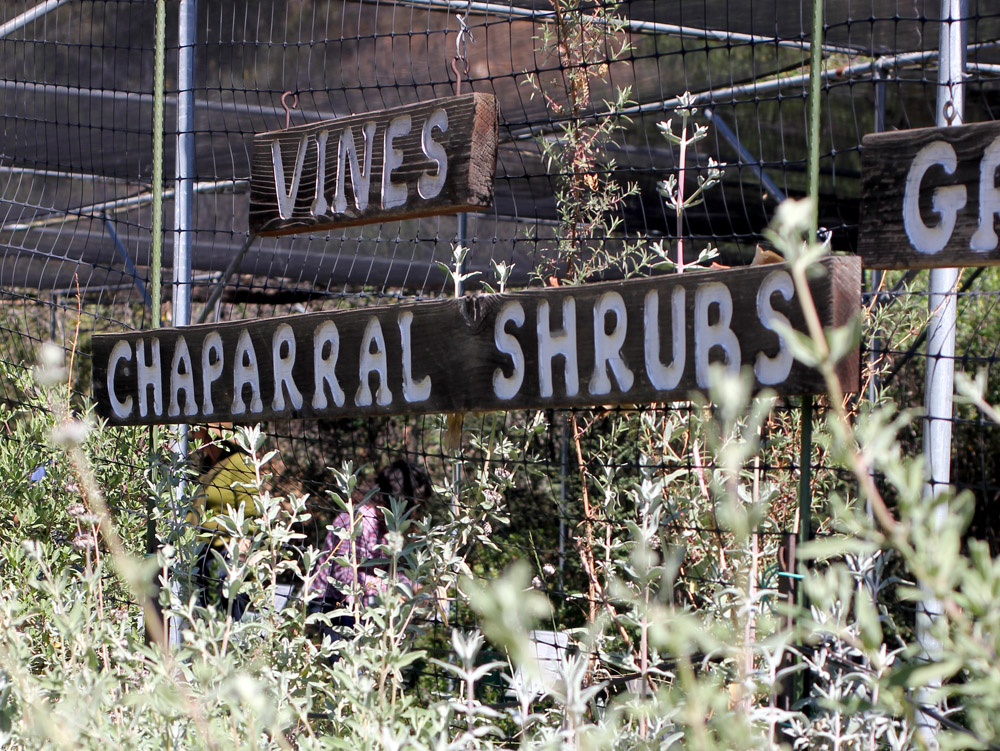

There are also very helpful signs for each plant which show the plants ideal soil and sun requirements as well as how large the plant will get.


When planting for honey bees the ideal is to select plants that will bloom in different seasons throughout the year. For example Coyote Bush, Barberry and specific types of Manzanita. Some of the other native plants mentioned in the lecture for honey bees are Ceonothus, Fairy Duster and Lilac Verbena (both of which bloom nearly all year long), Toyon, Buckwheat, Sage and Matilija Poppies.


Pictured above is a honey bee on a beautiful Ceonothus that was in full bloom with the most delicious botanical perfume! I can just imagine how fantastic Ceonothus honey would taste.

If you don't have a yard, no worries, you can grow the natives in glazed pots or oak half barrels available at local nurseries like GreenArrow and Osh. Since these plants will be in a confined space Lisa suggested getting an organic planting mix with bat guano and sea kelp for extra nutrition. Water only when the soil is dry. Lisa explained that a very simple test is sticking your index finger one inch into the soil. If the soil is warm and dry its time to water, if it is cool and moist, no water. This simple method also applies to new plants placed in the ground.


While meandering around the nursery I caught site of what looked like a little violet flower. I looked at the sign and sure enough it was a violet, native to California and had a lovely smell! These will be going in a shady area of the yard that at the entrance of the studio.


It was a really fantastic morning. Many thanks to Mark of the Backward Beekeepers who organized this event and to Lisa Novak whose passion and commitment is contagious.

Photos of the Planting for Pollinators event at TPF ©Roxana Villa. The Anise Swallowtail is from the U of CA Botanical Garden at Berkeley. The Western Green Butterfly image via Google.

Wednesday, October 10, 2007

The Garden, part 2

Last Friday was the first day of the Native Pant Sale at the Theodore Payne Foundation. We are re-doing our landscape to incorporate as many indigenous plants as possible. Early last Friday my mom and I trekked out to Sun Valley to purchase natives. I arrived back in the Santa Monica Mountains with a treasure trove of new friends to plant into our clay soil.
The first weekend sale is for members only. I purchased quite a few Ceanothus, which will cover the majority of the front slope, intermingled with Yarrow, Manzanita and Sage and Island Alum under the Oaks. We will need to return again for more plants. Planning the garden has been like formulating a painting or perfume. All the elements of design must be employed; texture, repetition, contrast, scale and a unifying theme.
The Ceanothus consists mostly of 'Yankee Point' with a few 'Heart's Desire' and 'Centennial'. Eventually we will also plant more Oaks as well. I plan to experiment with all of these for the tinctures in my Californica series of perfumes. Some are already in Vera and Chaparral. The new perfume to this series, Rosa and Sierra, also contain local native tinctures. Rosa and Sierra will be available soon. Thank You to all of you who have sampled them and are patiently waiting for the quarter ounce liquid perfume. Californica samplers will be available as well.
The Native Plant Sale at the Foundation opens to non-members this Friday. I suggest getting there early with a list and plenty of time. Plastic for the interior of your car, gardening gloves, full water bottle and a notepad are also a great addition for the trek. If you need help, seek out Louise, she is very knowledgeable and friendly. While you are there sign up to be a member. Membership helps support this important non-profit. Members get a discount on plants and classes, as well as receiving the Poppy newsletter filled with native plant garden tips.
Why go native?
1) Aesthetic Value: A native garden is stunning and fits the authentic beauty of California.
2) Once established native plants require very little water!
3) Genetics, these native plants only exist in California, the genetic material thrives here. Why create a garden with plants indigenous to the east coast of Europe when we have a plethora of 6000 species of plants. Natives are considered "Pre-European", they evolved without human impact. By continuing to plant natives we avoid genetic contamination and cross pollinating.
A paradigm shift is required when we first begin to look at natives. The color and texture palette is quite different. Similar to the adjustment when we shift from synthetic to botanical perfume. We make a choice that positively impacts our health and the wellbeing of the land.

A really beauty filled native garden to visit is the one at the Santa Barbara Botanic Garden located in the foothills, up Mission Canyon Road. Not to be missed is the Redwood Forest residing next to the
dam. SBBG offer several docent guided tours which I highly recommend.

When you become a member of the Theodore Payne Foundation you will be given a fantastic book, conveniently in both English and Spanish. Another fantastic book is California Native Plants for the Garden.
The Theodore Payne Foundation
The Santa Barbara Botanic Garden

This photo was taken in 2005 at the SBBG. The structure in the background was created by Patrick Dougherty.
Patrick Dougherty Installation

Monday, April 14, 2008

The Genius of Nature


“Nature is full of genius, full of divinity;
so that not a snow flake escapes it’s fashioned hand.”
~ Henry David Thoreau

Two major events, dear to my heart, occurred this weekend on opposite coasts. The Sniffapalooza Spring Fling in NYC and the Native Plant Garden Tour here in Los Angeles. Alas, I was not able to attend this years Fragrance Event in NYC instead, I was immersed in the aromatics and beauty of California natives such as: Ceanothus, Artemisia, Salvias and the California Rose (pictured above). As a native plant advocate and a member of the Theodore Payne Foundation I decided to volunteer as a docent for this years garden tour. On Saturday we toured approximately five gardens with my mom while Sunday Greg and I were docents for a location in Encino consisting primarily of wildflowers (pictured at left) in a Walnut Tree woodland.
The native gardens on the tour are so inspirational, it really makes you wonder why more folk haven't caught on by now, especially with our water challenges. Perhaps this years
garden will spur on more consciousness in this realm.

Here are just a few of the benefits of California Native Gardens:
  • Only 7% of insects can eat non native plants. Without insects to convert plant material to protein, most higher land animal forms will go extinct. Insects are an important protein source to our lovely songbirds. Native plants maintain bio-diversity.
  • Native plants require very little water, once established. In fact some of the gardens on the tour are only watered six times throughout the entire year! Compare that to those thirsty lawns that have become emblematic with Los Angeles suburbs.
  • Native plants require no soil amendments, no fertilizers or pesticides. What a paradigm shift huh! Just put them into the existing earth.
The trick is to select the right plant for your area and not to over water!

The California iris is called Iris douglasiana. Pictured above are a spattering of the different Iris hybrids offering a variety of color and shape.

The most interesting fact I learned this weekend was that the town of Encino, in Los Angeles, was named after a non-native oak tree! The Holm oak, Quercus ilex, is native to Spain, and resembles our native coastal live oak in that it is not deciduous like most European oaks. In Los Angeles and the surrounding areas we have many towns, cities and communities named after Oaks: Encino, Sherman Oaks, Woodland Hills, Thousand Oaks and Los Robles to name a few.

Within our line of botanical perfumes we have four fragrances based on the California landscape, some of which utilize tinctures of native plants. The California line consists of "Q", Chaparral, Vera and Sierra. We intend to release a new perfume, which has been in the works for about five years, within the next month. Can you guess what it will be? To read more about our Californica botanical perfume series click here.

Pictured at right is the California Poppy.

Sniffapalooza
Theodore Payne Foundation
Roxana Illuminated Perfume™

The photos were taken at this weekends native tour ©Roxana Villa.

Friday, July 24, 2020

The alchemical trinity of Chaparral


The perfume Chaparral is not a reference to the creosote bush, Larrea tridentata, which sometimes goes by many name chaparral, as well as greasewood and la gobernadora. I named the fragrance after the California biome distinguished by wet winters, hot summers and drought-tolerant shrub land. This biome is also found in the Mediterranean, South America, Australia and South Africa. The word chaparral comes from the Portuguese and Spanish word “chaparro" meaning evergreen oak shrub land.

Back in 2006, when Chaparral was conceived and launched, my intention was to bring awareness to this community of plants which are very undervalued in Los Angeles where residents opt for pesticide and water hungry lawns and non native palm trees, rather than the local sages, artemisias, oaks, etc. 


In creating the perfume Chaparral®, I weaved together my love and commitment to the indigenous plants of California with skills in aromatic plant preparation and the artistry of perfume formulation.

“Art arises when the secret vision of the artist
and the manifestation of nature
agree to find new shapes.”
~ Kahlil Gibran

My husband, Greg Spalenka states that there are three main components of great art which applies to the full spectrum of the sensory realm including visual, auditory, culinary and olfactory orchestrations.

He adheres to these three components as a trinity of "Mind, Body and Spirit":

Mind; the idea and/or concept
Body; representing the materials
Spirit; the love, passion, integrity and/or soul nature

In alchemy the trinity is Sulfur, Mercury, and Salt, code words for what is also referred to as "Soul, Spirit, and Body"

Sulfur = Soul = Consciousness 
Mercury = Spirit  = Mind
Salt = Body  = Mineral

So if we go back to Greg's trinity, I have overlayed Greg's trinity with that of alchemy in this way, substituting Greg's word Spirit for Soul/Love.

Mind; the idea and/or concept / Mercury = Spirit
Body; representing the materials / Salt = Body
Soul/Love, passion, integrity and/or soul nature / Sulfur = Soul, Consciousness

All these components, working together at a high level of sophistication and awareness, create a synergy, where each component becomes more than the sum of its parts.

In perfume the mind aspect (Mercury) is the concept that the fragrance is built on, encompassing much more than a scent based on a fragrance family or type. The body aspect (Salt) is made of the materials contained within the perfume, the artist’s palette. Soul (Sulphur) is the burning passion of your creation, this is where the true artist weaves their own authenticity into the constructed artwork using their consciousness. Each is important and is required for the finished art to transcend the ordinary, to reach the heights of the sublime.


Over the last twenty years I have come to keen realizations regarding California natives and their value. The journey beginning with guided instructional walks led by herbalist David Crow back in the 90's when he would lead nature walks in the Santa Monica Mountains. Davids introduction than deepened with lessons from communicating with the mighty Oaks on my property and its surroundings, when we lived in the Santa Monica Mountains.


The California native Coastal live oak was the one who spoke to me and revealed the value of native plants just as I began organizing my community to protect four large trees on an lot next to us. In an attempt to secure the safety of the trees I created a perfume devoted to them. The perfume is called “Q” for Quercus agrifolia and was the first in a series titled Californica.


The second perfume in the series, Chaparral® was birthed in October 2006 when I was researching incense. Incense was used by a variety of cultures depending on the plant material in their particular region. The indigenous people of California use the sacred white sage, Salvia apiana, to clear a space or fumigate an individual. I chose to create an incense themed perfume devoted to the California indigenous people based on the plants of the area.


The trinity mentioned above works in Chaparral like this:

Mind/Concept | Mercury/Spirit: The native plants of California, the chaparral.

Soul/Love: The soul nature of this perfume is expressed through the mindful harvesting and preparation of the plant material. The fragrance is created by hand with an intention to expand awareness of native plants.

Body/Material: actual, vital plant material used in tinctures and essential oils to represent an “authentic” fragrance of the regions native plants.

California native plants add tremendous value to a California garden including: authenticity to a landscape design, low water needs, benefits to wildlife habitat, increased biodiversity, and the ability of these plants, particularly the Coastal Live oak, to sequester carbon. Learn more about the chaparral at the website for the California Chaparral Institute.

Related links here at the journal:

Tuesday, May 12, 2009

FLOWER POWER


The hillsides of California become ablaze with the blossoming of native flowers in March and April. The California Lilac known as Ceanothus and the wildflowers like the Lupine and Poppies start off the colorful festival.

To my delight I had the opportunity to experience the bounty of California's floristic spring treasures twice this weekend. On Friday morning I drove over to visit my friend Meghan who lives in the Malibuo Lake region of the Santa Monica Mountains. Meghan is a treat to spend time with, she is a smart and adventurous soul with a warm an loving heart. Her knowledge of California plants is quite vast and she has the mind of a scientist, the heart of an artist and experience of tracking. The sum of all those parts equate a grand time whenever I have the opportunity to visit with her.


I drove along Mulholland Highway out to visit my dear friend who is currently working on a masters degree in English and had just gotten back from South Africa. The morning drive was glorious with the blue expansive sky above me and the glorious California landscape dappled with native oaks stretched out before me. Buried teenage memories of treks to Junior Lifeguard Camp at Zuma beach bubbled to my mind and made me yearn for a dip in the Ocean.


Our mission with Meghan was to find a specific patch of Rosa californica, native wild roses, that grow en masse and were most likely flowering. Meghan had taken me to this same exact location back when I was researching the plant for the Rosa botanical perfume. At that time the flowering shrub was dormant. When we came upon the cluster this past Friday I was thrilled to see them flowering and deliciously seduced by their hypnotic fragrance.


From their we continued our journey along the trail to witness the blossoming of several other native flowers. We also encountered native turtles swimming in the Creek. This natural water source begins in Simi Valley at Hummingbird Creek and travels all the way to the Pacific Ocean weaving it's way through several cities and the Santa Monica Mountains.


On Sunday the second adventure into California native plants presented itself as a trek out to Claremont to visit the Rancho Santa Ana Botanical Gardens. I had been told about this vast native garden at the foothill of the San Gabriel Mountains while at a landscape design class at the Theodore Payne Foundation.

It took us a good solid hour to get out there with part of the journey along the infamous route 66. The gardens are extremely beautiful and display up to 70,000 plants with 2000 California native species on 86 acres of land. Founded in 1927 this is an ideal location to view the extensive variety of color, texture and pattern.


Rancho Santa Ana Botanical Gardens is closed part of the year, so plan your trip accordingly and be prepared for an awe inspiring experience that will open your mind to what California native plants are. Far different from the stereotypical cactus plants that so many associate with Southern California.

Photographs©Roxana Villa, opening shot was taken at the Santa Barbara Botanical Garden. Other photos were taken in the Santa Monica Mountains and at the Rancho Santa Ana Botanical Garden.

Tuesday, February 12, 2008

All About Leaves


Let us praise “Leaves” today, for they are a crucial component of our survival on Spaceship Planet Earth. Daily we exchange oxygen and carbon dioxide with these lateral outgrowths which come in all shapes and colors.

Leaves are one of the categories used to classify the essences included in the Botanical Perfumers palette. A myriad of systems can be utilized to organize our volatile plant materials. This list is by plant part:
  • Aerial Tops
  • Bark
  • Berries
  • Buds
  • Grasses
  • Fruit/Zest
  • Leaves
  • Needles/Twigs
  • Petals
  • Rhizomes/Roots
  • Resin
  • Seeds
  • Wood

Essential Oils are stored in the internal or external secretary structures of the plant, referred to as glands. In leaves the presence of essential oil is usually a survival tactic to prevent insects from eating them. This differs from essential oil rich flowers whose fragrance invites pollinators.

This Saturday, under a brilliant blue sky and warm sunshine, Greg, Eve and I attended a class titled “All About Leaves” at the Theodore Payne Foundation. This important organization is located on twenty two acres in the foothills of Sun Valley. Our teacher Lisa Novack took us on a multidimensional journey. We closely observed the leaves of eight different native plants within the Chaparral, Coastal Sage Scrub, Riparian and Woodland Habitats of the Los Angeles Basin. We learned the various adaptations of California native plant leaves and conducted three scientific experiments.

Native plants in California are mostly found in the park lands. Unfortunately Los Angelenos have created water hungry gardens throughout the city utilizing nonnative plants. This ignorance has created a host of challenges, most obvious the huge amounts of H20 needed from the Colorado River Delta to water thirsty lawns. The current ideal garden in the minds of City of Angel inhabitants is one appropriate for rain rich climates like England. One can hardly blame them since plant nurseries rarely stock many natives. The palm tree, now the emblematic symbol for Los Angeles isn’t even a native tree! We now have the regular removal of native Oak trees for construction of Mediterranean mini mansions that landscape using palm trees instead of our large canopy and rich leaf laden Coastal Live Oaks. Worse of all the LA Department of Building and Safety and the Urban Forestry Division ignore our protected tree ordinance. Can you tell I am angry?

The good news is that there is some awareness beginning to take place. As water prices rise, homeowners will look for other options. California Native Plant gardens are quite beautiful, require little to no water once established and are essential to our local, community ecosystem. Did you know that only 7% of our native insects can eat nonnative plants? Insects are a crucial part of the cycle of life, providing the most important food source for our bird population.

I am currently enrolled in a California Native Plant Design Class at the Theodore Payne Foundation. The intention for our garden is that it will inspire others to Go Native!

Theodore Payne Foundation
California Native Plant Society
California Oak Foundation
The California Chaparral Institute


The images are all old engravings which I placed on pieces of parchment in Photoshop.

Wednesday, January 14, 2009

The Heart Note


In Perfumery terms we refer to the heart note, or middle notes, as the scent of a fragrance as it evolves from the initial hit of the top notes. As the first fragrance impression dissipates the next progression is the heart of the perfume followed by the lingering base. The heart notes represent an important turn in a well constructed perfume and are often where the soul of a fragrance can be found. In garden design a tree, like the middle note of a perfume, provides the heart of a landscape design.

California offers a wide variety of splendid native trees which are beautiful, provide habitats for wildlife, offer color and fragrance as well as shade. Now in January is when some of these trees lose the last of their leaves and provide interesting structural forms in the landscape. The leaf litter is rich in nutrients. Instead of gathering up decomposing organic matter provided by nature, use the leaf matter as mulch. Oak and pine are ideal for this purpose. Mulch is beneficial in the garden because it helps retain soil moisture, moderates soil temperature, suppresses weeds and adds natural beauty to garden.

The native arboreal delights include:
Calocedrus decurrens, incense cedar
Platanus racemosa, Western sycamore
Quercus agrifolia, coastal live oak
Quercus lobata, valley oak
Quercus engelmannli, Engelmann oak
Pinus ponderosa, ponderosa pine
P. torreyana, Torrey pine

On our property we have a bounty of native oaks including the Quercus agrifolia, coastal live oak and Quercus lobata, valley oak. As you will notice, the palm tree which regrettable has become emblematic of the City of Angels, is not on the above list.

Here in the wooded hills of Los Angeles our native oak grooves are being disseminated for the purpose of housing developments, McMansions and just plain ignorance. In many cases old oaks will be removed and replaced by non native palms. The palm provides a specific appeal to those wanting to create a fantasy location such as the middle east or the tropics. Palms provides little to no shade and do not contribute to native biodiversity.

This month we will be speaking out to protect a few grooves in our local woods. To learn more about California native plants visit the Theodore Payne Foundation where you can purchase a few woody specimens as well as learn all about the delight of California flora. Save Oak Savanna provides support and is hard at work protecting wildlife, open space and native oaks as well as informing, organizing and educating the local community.

I created the Californica series of perfumes in an effort to contribute to spreading the word on native plants and facilitating consciousness to this realm. Each of these perfumes hold the intention to evolve the consciousness of humans to the value of the plants, specifically those that are native to the California biome. "Q"(for Quercus agrifolia), was the first in this series,  followed by  Chaparral™ and Sierra.

Thank you to Lili Singer of the Theodore Payne Foundation for her article titled "Native Trees, Please" in the Poppy Print Winter 2009 issue. Her contribution was the inspiration for this post and provided much of the valuable knowledge. Please refer to her article for more in depth information about native trees.

Roxana Illuminated Perfume™
The image of the Philosophical Tree is by J.D. Mylius created in 1628. Old oak leaf engraving was placed on of parchment using photopshop, Tree image is ©Greg Spalenka.

Thursday, January 30, 2014

Night blooming and heady!


In the woodland today skies are grey with a chance of rain and the rich, heavy fragrance of the night blooming pink jasmine is in the air! The aroma of this jasmine is much heavier and sweeter than the sambac, in fact, it is so strong that I can't tolerate too much of it or I get a headache.


Everything is blooming about one month early this year because of the strange warm weather we've had. The challenge with this, especially the fruit trees, is the danger of frost in the next few months.


In other local news, a developer has decided to build a monstrous box on the site where the native oaks were cut down. I've spent the morning looking over the plans brought over by a neighbor. There are all sorts of challenges with the building plans that go against existing codes for that particular property. The landscape plan was particularly interesting since it is mostly California natives. The problem however, is that they've chosen plants which are native to the Bay area not here in the sunny, hot woodland of Southern California. (Hello?)

Clearly the landscape designer, which by the way has the same last name as the contractor, didn't expect to have a local resident and lover of native plants looking over her design with a fine tooth comb.

Our landscape design is mainly California natives, the back slope is covered with rosemary which I am very happy with since the bees adore it. All my jasmines, exotics and medicinal plants are in pots. We've chosen native plants...or perhaps better verbage is "the native plants that have chosen to be in our garden design" tend to grow in the local woodland and our beloved by the local fauna and flora. This is my vision for every house in the neighborhood, imagine what a fabulous and positive environmental impact that would be!


Monday, April 21, 2008

The Sky is Open

We celebrated the earth this weekend in the Santa Monica mountains among divine beings. On Sunday we met some friends up in Topanga, hopped on bikes and scooters and made our way to the Topanga Earth Day Celebration. Through the chaparral scented breeze, winding amongst oaks,we headed toward our destination. I was very keen on meeting Cecilia Garcia, a Chumash Indian Medicine woman who was speaking on the medicinal qualities of California native plants. We parked our bikes at the base of the secret entrance and wound our way up the mountain. I shot off to the tipi where Cecilia and her comrade James Adams were standing before an array of sages, artemisias and other herbs. We were instructed to sit, take a stalk of white sage and break it where it wanted to be broken. After doing so we took the hollow piece and put it to our mouths like cigars. We breathed in through our mouths and out through our noses, taking in the energetics of the sage. As we did this we were also instructed to clean the leaves of our stalk, thus insuring even more communion with the plant. After soaking a plethora of information from Cecilia and James we ventured off to take in the very “hippesque” sights. To my enormous delight, one of my all time favorite songwriter/musicians was scheduled to perform within minutes. I couldn’t believe the good fortune. Donna De Lory is a musician I was introduced through one of my yoga instructors. Donna is local to Topanga, she melds ancient sanskrit chants with modern sounds seamlessly. So much so, that for me she is the voice of the Divine feminine. On stage she is even more magnetic, in person she is enchanting.


At the end of the day yesterday I was in bliss with profound gratitude for the earth, the native plants and our beautiful friends. The aroma of sage will now forever be affiliated with BLISS!

Cecilia Garcia does not have a website, however, she will be teaching at the Theodore Payne Foundation this May. We have been in contact with her and James about doing a class here in Woodland Hills. Stay tuned.
Chumash Healing with Native Plants at Theodore Payne Foundation

On May 3rd Donna De Lory will be appearing at Exhale in Venice and then traveling to the Omega Institute in NY. Here are various sites to visit and listen to her exquisite music.
Donna's website
and her blog.
The title of this journal entry is named after Donna's new album "The Sky is Open."

The photos were taken at Topanga Earth Day: a display of California native plants and Donna on the main stage with her band.

Tuesday, June 10, 2008

Sensing Organisms


In the nineties, when I created illustrations 24/7, I contributed an image for an article in National Geographic on how plants communicate with each other. Recently I've come to learn about the inherent wisdom in California native plants, including the way they share water with each other and network for the greater good of the community.

In the Science section of todays New York Times there is an article titled "Loyal to Its Roots" regarding the inherent wisdom within plants. The article mentions the California dodder, a plant we've recently noticed on our walks in the Santa Monica Mountains. Being fans of fantastical art forms we invented a story about it being a plant from outer space. Surely when you see its bright, neon orange color, among the other subdued coloring of native plants, one would assume it's a transplant from another planet. Who would have guessed it's a California native! I haven't checked to see if it has an odor.

There is a terrific book that came out in the seventies, briefly mentioned in the NY Times article, called The Secret Life of Plants. A must read for all those devotees of the plant kingdom.

New York Times Article: Loyal to Its Roots
California dodder
Roxana Illuminated Perfume™

The illustration above is not the one used in Nationa Geographic, that one I can't seem to find a scan of. The image above was a cover of a Business magazine ©Roxana Villa.

Thursday, October 2, 2008

Elfin


The LA Sniffapalooza, also termed Fashion Fragrance West, has only a few seats left. Here is a link to read the latest update of participating perfumers, stores and giveaways.

At the LA event I will launch a new perfume that has been in development since March 2005. It began as a complex accord and has gone through all sorts of flips and wiggles, shape shifting regularly. Finally in June of this year, as I was conducting trials for a solid perfume, clarity broke through. I realized sage was the key component.

This perfume is the next in the Californica series, following last years debut of Sierra. I choose the word Californica because it is the species name found in many plants native to California, for example Artemisia californica. (Artemisia is the genus, californica the species.)

I've decided to keep the perfume a secret so that the Sniffapalooza members will be the first to experience the fragrance. Anyone who has been reading this journal regularly may already know which native plant this perfume is based on. The couture pouch, which will house the French glass flacon, was created last Spring. In fact last Spring was the scheduled release for the fragrance. Interesting because the formula back then was not nearly as animalic as it is now. The perfume will also have a companion version as a solid in a antiqued compact.

This mystery perfume shares some of the same accords and tinctures found in Q, Chaparral, Vera and Sierra. A few days ago I realized that this was the fifth perfume in the series. Did you see the film the Fifth Element? Do you recall what the important fifth element was?

My friend Meghan introduced me to this plant which inspired the upcoming fragrance. Up until a little over a year ago, I didn't even know it existed. The native plants of California are a bit mysterious unless you hike regularly in the local hills and pay close attention, beyond the sages. In one of the books lent to me by Meghan, the plant community is referred to as An Elfin Forest. The reason for this name is that one must look closely to indeed witness the magic held in these plants, most of which are quite low to the ground. Besides the elfin sized flora, the fauna found in this community are also quite small.

"These are indeed strange days.
Dreams and legends spring to life out of the grass."

~ Eomer, Lord of the Rings

It seems to me that Natural/Botanical perfume and California native plants both share a magic only revealed to those who stop, and with keen observation, begin to truly witness the secrets of an authentic landscape.

Roxana Illuminated Perfume™

Friday, April 15, 2011

Restoring the Wood Land


Over ten years ago when we moved into our little house here in the woods I was fairly unconscious of California native plants. The house had been landscaped in the typical manner with plants that required huge amounts of water, fertilizers, etc. Heck we even had a lawn!

It was the incident with the oaks that opened my perception to the fact that there was a biome here in California called "the chaparral" consisting of specific plants quite different from what is sold at our local nurseries. The foray into this new botanical world has been quite a fortuitous venture, aligning us more closely with living authentically.

Sage

The journey began with the California oak and the intoxicating aroma of the local sages. Slowly we began to remove and give away the non natives in the garden. First to go was the ivy along the side of the house, then as our awareness grew, we let the grass die off and replaced it with bark mulch. Next we began pulling out the vinca which covered almost the entire front slope and the water hoarding non-bee loving plants bordering the house.

Sage

Once cleared I began planting and studying about California natives. To my surprise they would need NO special soils, NO fertilizers and would eventually require little to no water. What a mind bender! However, there was much work to be done on the mind, for many habits would need to be broken.

Ceanothus flowers

Over the years I've learned that the natives that do the best on our little patch of earth are those growing here in the local mountains. The different salvias, sages, have been particularly happy. Currently there are species of apiana, clevelandii, leucophylla, mellifera and spathecea. I lost several ceonothus plants before one finally took hold in the ground and another in a pot, both with beautiful blue flowers. Along the bottom portion of the slope I planted Rosa california, our native rose. Under the oaks I've planted different species of heuchera which are doing fairly well, although some have departed.

“It is a golden maxim to cultivate the garden for the nose,
and the eyes will take care of themselves.”
~Robert Louis Stevenson

Huechera flowers

Ceanothus sprout

Last week while weeding I began to spot small sprouts of natives coming up on there own. Tiny little plants volunteering themselves to grace our property. I marveled as I discovered ceonothus, artemesia, rhus ovata and roses, not to mention a plethora of baby oaks. This abundance of riches is likely due to a restoration of the dirt to its natural ph along with the honey bees and local fauna that visit the garden regularly. Our property is now circled by oaks from ancients over fifty years old down to the tiniest little sprouts.

Rosa californica sprout

Quercus agrifolia

Inch by inch we continue to work on the restoration of our woodland microcosm with an intention of affecting the larger macrocosm.

I leave you with a non-native drought tolerant image of a rockrose flower, of the genus cistus. One of my very favorite materials for creating botanical, natural perfume is dervied from the resin formed on the leaves of Cistus landaniferus, the essence is known as Cistus and Labdanum.


Photos by Roxana Villa and Eve Neuhart