Showing posts with label tree. Show all posts

Wednesday, August 19, 2020

New Mexico Adventure: Las Conchas Trail

On Monday, August 17th, we decided to head toward the Jemez Mountains and River to get some forest bathing in from a different area than our usual fifteen minute drive up to our local woods. Since we had not been to the area, and most of the lodging sites that met our criteria were booked, we deemed the trip would be more of an "exploratory mission" for a grander, future adventure.

Los Alamos


From Santa Fe we headed North for 35 miles, up winding roads toward the town of Los Alamos where we stopped at the French cafe Fleur de Lys to grab a few items for a picnic in the forest. I find the city of Los Alamos slightly creepy, mostly due to its history with creating nuclear weapons and the Manhattan Project where the government recruited scientists to live as virtual prisoners during the infamous Manhattan project. There is a quiet, unsettling energetic quality in the Los Alamos area, reminiscent of The Hawkins National Laboratory from the Stranger Things TV series or perhaps a better example is the high-security facility in Guillermo de Toro's The Shape of Water.
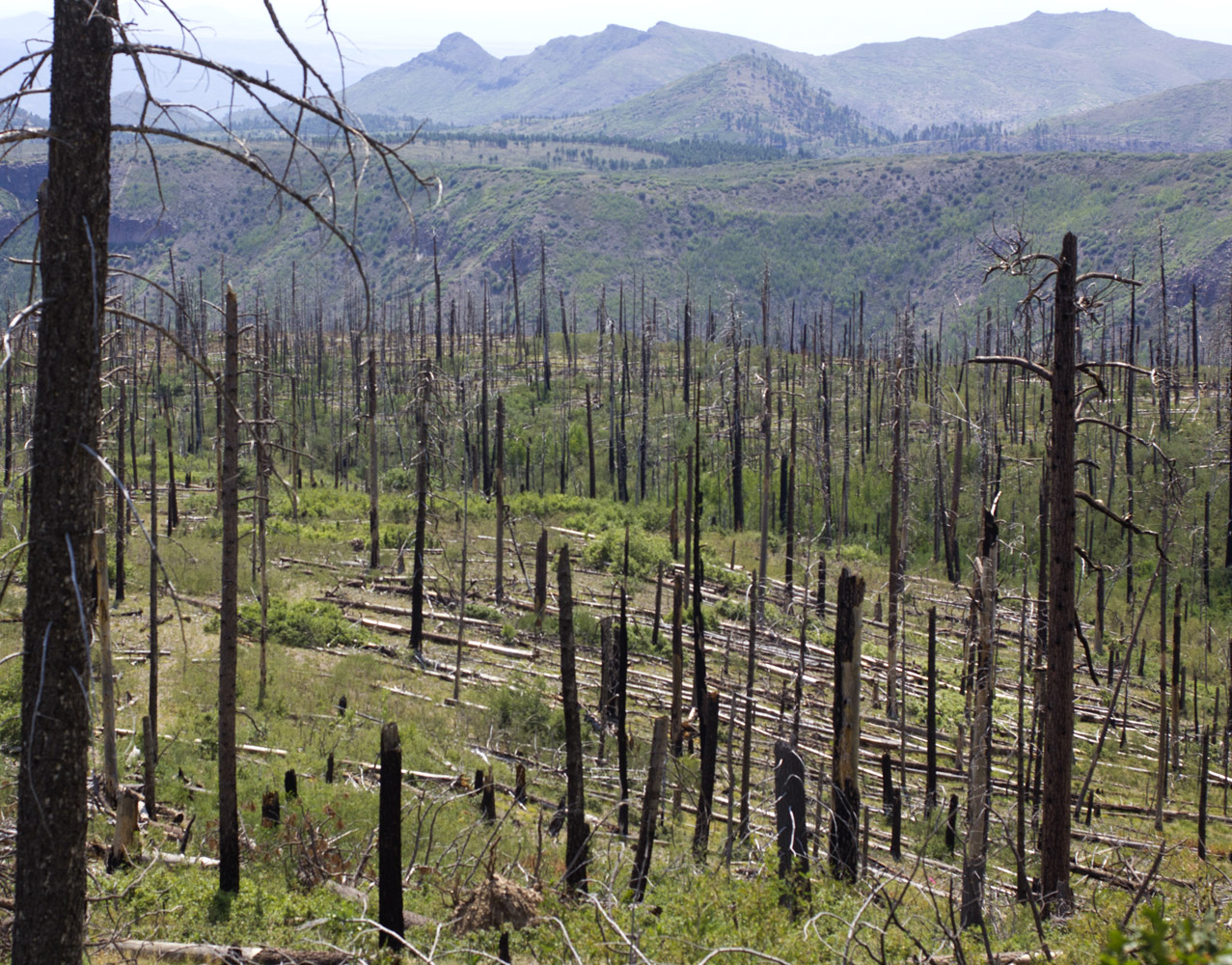

As we drove through the town, past Oppenheimer Drive, (named after Julius Robert Oppenheimer, the theoretical physicist credited with being the "father of the atomic bomb") that uneasy feeling continued, exasperated by the charred trees viewed topping the mountain above the city. The skeletal trees sticking up out of the landscape like matches were due to the Las Conchas Fire of 2011, that burned over 150,000 acres. Both Greg and I felt emotionally impacted by the sight of the devastation. Little did we know that a fire had started in the Rio En Medio area of the Santa Fe National Forest. Perhaps on an unconscious level we were picking up on it.

Luckily the forest that burned in the Las Conchas wildfire is slowly coming back, evident by the scrub oaks and aspens. I asked a Forest ranger about this and she confirmed my suspicion explaining that pioneer trees appear first. The scrub oak is one such tree, arriving on the scene early, as a slow-growing tree that are unpalatable to livestock and thus able to mature at significantly reduced sizes in arid, nutrient-poor soils, under harsh conditions. Other common pioneer tree species include red cedar, alder, black locust, most pines and larches, yellow poplar and aspen. 1

As the scrub oaks become dominant, their crowns form a thick canopy laying down a layer of leaves to produce mulch and, eventually, soil. By the time they have matured (which can take 40 years or more), the oaks have produced a layer of relatively rich, crumbly topsoil under a mulch of forest litter. With continuous cover, the forest soil will now be shaded and cool, and humidity within the environment is increased providing hospitable conditions for the taller trees to move in. They could not have survived in the harsher environment which the scrub trees prefer. But thanks to the enhanced soil and air created by the scrub forest, the taller trees are soon thriving. They’ll eventually shade out the older, shorter, slower-growing scrub. Once that occurs, then a “climax” forest has begun to form. At this point, the woodland is returning to a steady state of relative stability, and is on its way to becoming a mature forest once again. 2

This is reminding me of the slow moving Ents from Lord of the Rings, and how human time is completely different from the great cycles of nature and trees.

Valles Caldera

Continuing on our journey along Highway 4, we descended down into the Valles Caldera National Reserve, the site of "a spectacular volcanic eruption created the 13-mile wide circular depression now known as the Valles Caldera"3 over 1.25 million years ago.


The beautiful view of the Valle Grande meadow contains what appears to be an island, Cerro Jara, rising out of the expanse of prairie. It was humbling knowing that we were standing on the site of major magma flow as recently as 50,000 years ago. For context, the incident which created this magnificent valley was formed by an eruption 500 times greater than that of Mt. St. Helens in May of 1980! Regrettably the photo above does not quite do the beauty and magnificence of the scene much justice.

Las Conchas

Continuing along highway 4 we arrived at what we thought was going to be the first stop on our adventure, the Las Conchas Trail, which is located along the East Fork of the Jemez River. We parked and headed in stopping along the path to have our picnic lunch and then continuing along the scenic trail.


Thursday, October 6, 2016

Trees, a re-occuring theme


As a freshman in high school I was encouraged to join the Speech club, so I did. I chose to memorize and tell the Shel Silverstein story the Giving Tree. Fast forward, approximately forty years later I presented the Tree of Life at the National Association for Holistic Aromatherapy conference at Bastyr University.

Gosh, I realized I've bee telling the same story since high school not only speaking to groups but also with the fragrances I make. Perhaps you've come to the same realization at one of those rare moments when we see ourselves beyond the veils of this illusionary world we live in.


We have just entered the Celtic Tree Ogham of the Ivy which makes it an auspicious time to anoint ourselves with the green, mossy, forest fragrance Hedera helix, now back in stock as both a liquid and a solid.

Here is a YouTube video with Shel Silverstein reading the story:


The video Greg created of The Tree of Life presentation delivered at the Beyond Aromatics conference at Bastyr can be found here. I'm presenting "Scent and the Honey Bee" at this years conference, please join me on Sunday, October 23rd. My presentation will be soul enriching and you will have the opportunity to surround yourself with an inspiring community. Find details here.

Thursday, July 30, 2015

Oak Tree Circle


Yesterday, just as I was about to head off to the perfumery a gardener with a chain saw almost starting going at the oaks on the neighboring lot. We were able to fend off the fellow by taking photos and calling the police. Since I'm not sure if this method of protection will be sustainable I am asking each of you to encircle the seven trees in love and protection. If you have some Q Perfume than please anoint yourselves with this elixir devoted to the California oak.


Q
Fragrance family: WOOD, CHYPRE
Main notes: Resin, wood chord/accord, Italian bergamot, tinctured Coastal Live Oak leaves


Return of the Light
A New Green Cloak
Q Queurcus agrifolia - Reviews
+Q Perfume - Review
Celtic Lunar Month Oak - Reviews & Links
Ode to Trees
Celtic Lunar Month: Oak
Q Review - Review
The Green Man
A Secret in the Forest
The Duir Way
Save the Oaks
Scent of the Day: Oak
Spirit of Nature
Medicine Wheel


Monday, January 6, 2014

Movie Monday: Climbing Redwood Giants


In 2007 I was gifted the book "The Wild Trees" by Richard Preston. I became immediately absorbed in the adventure of a group of botanists, naturalists and the visionary pioneer at the heart of the story, Steve Sillett.

National Geographic recently did a documentary that includes Steve Sillett. Here is excerpt from the YouTube page and a three minute clip:

"Clip of the Winner of the International Forest Film Festival They are living giants, one of Earth's largest and oldest trees. Some tower more than 350 feet high, taller than the Statue of Liberty; some may have been seedlings when Jesus was born. Yet, these natural legends still shroud centuries-old secrets. In a major National Geographic cross-platform event, which includes the October, 2009 cover story for the magazine, we reveal the little-explored environment of the redwoods using high-tech aerial laser surveys and breathtaking imagery."


The fragrance Sierra is an ode to these majestic dwellers of ancient times. I've been experimenting with a body butter that has a similar aromatic blueprint. Also, on the agenda is to make more of the liquid.


The article that appeared in National Geographic titled can be found here.

United Nations Forum on Forests website.

The book is available directly from Richard Preston, the author, at his website.


Saturday, September 7, 2013

Sonoran Desert to Alpine Forest


Greg was contacted by a friend who lives in Palm Springs to begin a dialogue about a collaborative project which resulted in a little mini vacation for us with a free stay at a spa for a few days. Palm Springs, like Las Vegas, is not at the top of our travel destinations, but who can resist a stay at a luxury spa which included a massage! 

Palm Springs is an enigma to me, no big surprise considering my devotion to the nature and authenticity. There's something irreverent to me about bringing huge amounts of water, electricity,  lawns, chlorine, gambling and non-native, invasive plants to the desert. I don't feel the violation as much in other desert locations like Sante Fe or Taos.

Besides the spa the other highlight was the San Jacinto National Park. Greg insisted that we take the Palm Springs Aerial Tram up to the top of the mountain where the vegetation and temperature due to the micro-climate was dramatically different. I was looking forward to being amongst some authentic greenery but I had no idea what a haven I was about to encounter.

The Palm Springs Aerial Tramway is a spectacular feat of engineering. The journey, on a normal day, is a quick breath taking 10 minute ride, covering 2.5 miles from the base Valley Station to the top Mountain Station located at 8,516 feet. As you ascend five different life zones beginning with the Sonoran Desert to an Arctic Alpine wilderness.


When we bought our tickets to take the tram we were told that there was heavy rain up at the top with no signs on what the rest of the day held in store. We choose to venture on up, rolling the dice that the clouds would eventually move on. As the tram begin to climb the to the 8500 foot elevation it would automatically stop occasionally due to lightning. Eventually we arrived at the top where light rain was falling. After a ten minute or so wait the rain began to turn into sprinkles and then disappear. The moment we witnessed the weather shift we immediately headed out of the stuffy lodge to the much anticipated wilderness.


Some of the plants of this Alpine wonderland area include; Artemisia douglasiana, commonly known as Mugwort; Coulter pine or big-cone pine, Pinus coulteri; Cottonwood, Populus fremontii, Juniperus californica, also called desert white cedar; Jeffrey pine, Pinus jeffreyi, also known as black pine; Lupine, Lupinus albifrons; Pinyon pine, Pinus monophylla; Scarlet penstemon; and White fir, Abies concolor.


Many trees had fallen naturally and or been struck by lightning, however, this forest is very healthy.


If you go, I highly recommend the Guided Nature Walk, which I will do upon our return visit to the area.


All photos ©RoxanaVilla.

Sunday, October 23, 2011

Heralding in Hedera Helix

This page has been created to list all the reviews and testimonials that come in for Hedera helix, the new, green chypre natural, botanical perfume for Ivy, one of the sacred plants of the Celtic forest and part of the Tree Ogham. Get your sample set here.

"I have been rolling in Hedera Helix ~ sweet green chili peppers surrounded by leaves of ivy and oakmoss and lightly sprinkled with powder. Um, am I crazy? Absolutely love this perfume!!!"
~ Customer


"SOTE: After a hot shower, the wonderful new Hedera Helix in solid perfume from Roxana Villa - a green lover's idea of paradise, and so calming too. Aaahhhhhh.... :-)"
~ Donna Hathaway

Roxana Illuminated Perfume Hedera Helix: Wouldn’t you love to receive the lovely compacts pictured above? I certainly would as they’re filled with Roxana Villa’s newest fragrance, Hedera Helix, an olfactory ode to ivy. Not surprisingly, this perfume is a leafy green chypre that has a dense and addicting note of oakmoss as its foundation. Both incarnations of Hedera Helix, solid and liquid, are a complex blend of nearly forty different essences, but I prefer the solid’s focus on the effervescent top notes of clementine, orange blossom, and grapefruit. (The liquid is much more resinous and inky and also very beautiful). The heart is full of warm beeswax and woods and the drydown is dappled with sweet rose and jasmine petals. I find this progression from chypre green to pale pink to be quite compelling and all together lovely.
~ Trish of Scent Hive

Saturday, September 24, 2011

Tree Ogham


The constant in Celtic tradition accepted by all the scholars is a deep reverence for nature, specifically the trees. Like the native people of the Americas, the Druids viewed the world holistically, seeing the connection between all things. There was an intrinsic understanding of the link between the physical/outer world and the spiritual/inner world.

Most of the Celtic myths we have with us in practice have evolved over time. Many have been interpreted into the modern Neo-pagan traditions based on the book The White Goddess by Robert Graves. The Tree Ogham has roots in Druidic history but is also part of the re-invention tapping into an inherent understanding of the Green World, the mighty trees and an understanding that magic and symbolism are dynamic and evolving constantly.

For the Druid's trees were sacred, an outward symbol of the cosmos manifested here on Earth and beings of great wisdom which held memory. When gathered together in a grove the vibrational field is heightened. The branches of each tree reaching up towards the heavens with deeply connected roots spiraling down into the womb of the earth. Sacred groves were referred to as nemeton, these were ancient sites of worship with very old trees. Many of these sites were cut down by invading Romans and later by the church as a way to dissipate the strength of the Druids and their holy places.

Regrettably humans have not learned the great value of our forests and trees, despite several movements throughout the world working diligently to save and restore our woodlands. Instead of the plight of Roman invaders and religious zealot now we face the Corporate entity with its ferocious, greedy appetite for all the natural resources Mother Earth has to offer. As an alternative the Corporation offers us synthetic, mass produced, industry made replicants.

As my continued contribution to the greening of consciousness I've created a new, ongoing series, based on the Tree Ogham, handmade with intention, respect, tinctures, infusions and the vitality of nature. They are great draughts of wisdom from the Green World, magical elixirs meant to connect each of us to the verdant entities yearning to share their knowledge and heighten our inner and outer awareness.

Let us begin with defining a few words and setting the stage. The word Ogham or Ogam is an ancient script developed most likely by the bards of Ireland in search for a sacred form of communication. Ogham script is seen as a line with smaller intersecting lines and notches most often carved into standing stones. Sometimes these lines could be found carved on trees and there are also individual characters with reference to specific trees. Ogham is also a form of linguistic communication that was used by "heroes, champions, bards, and druids"1 which most likely predates the script and alphabet. Steve Blamires, author of Celtic Tree Mysteries: Secret of the Ogham suggests that the Ogham language was not a spoken word but developed as an inner form of communication between us and the trees, or our own higher self.


The Celtic Tree Calendar is one of the Neo-pagan traditions mentioned at the start of this post. For the Druids our modern system of compartmentalizing time did not exist. They were deeply, spiritual beings living very much in the here and now, time was fluid and cyclical tuned into planetary movement. Even the Wheel of the Earth with its eight holy days stems from Celtic revivalists.

The Book of Ballymote has two Tree Alphabet lists both beginning with the letter B for Birch, one consisting of twenty four letters and trees and the other with twenty six. The Steve Blamires book lists twenty trees to begin practical magic work. This is the main book I am using for my inspiration as it is the one that feels most grounded and balanced.

Below is a list of the twenty totems within this Basic Tree Ogham, keep in mind that not all are trees, but plants found within the Celtic forest:

Birch
Rowan
Alder
Willow
Ash
Hawthorne
Oak
Holly
Hazel
Apple
Vine
Ivy
Broom
Blackthorn
Elder
Fir
Furze
Heather
Aspen
Yew

1 Celtic Tree Mysteries: Secret of the Ogham, Steve Blamires, 1987 Llewelyn Publishing
Images: Divinus and Graphic Tree on parchment by Greg Spalenka.

Friday, March 25, 2011

Branch Out


"The creation of a thousand forests are in one acorn."
~ Ralph Waldo Emerson

The rain from the last few days has caused quite a bit of challenges here in the wood lands. Many non-native trees, like the Pink Pepper Berry, have landed in the street. This morning one of the neighbors conifers was blocking the street on one side. It's still laying there, like a large corpse.

Los Angeles residents still haven't made the connection that the trees that continue to fall during these heavy rain storms are generally non native trees. Since Oaks are very deep rooted it is rare for them to fall, when this does occur it is usually because of grass, requiring regular watering, or cement/asphalt is at the base of the tree.

Speaking of Oaks, Q liquid is completely out of stock at the moment. I am not sure when this amber-licious botanical perfume will return, most likely sooner than later.

Friday, January 15, 2010

Celtic Lunar Month: Birch

""The Birch was very noble,
Armed herself but late,
A sign not of cowardice,
But of high estate.
"
~ "The White Goddess" by Robert Graves


The first tree that is honored in the of cycle of the Celtic Lunar Month Calendar, according to the Beth-Luis-Nion system, is the Birch.  The celebration began on December 24th and lasts until January 20th. Birch, considered the "Lady of the Woods" and the divine mother in Celtic lore, bestows to us the divine Sun. During her lunar reign we celebrate the Winter Solstice marking the return of the light. Alternately it is also associated with the return of the bard Taliesen (The Merlin) who is birthed by the Goddess Ceridwen.

The bark of the Birch tree is what designates the color association and species such as Silver, Black, Yellow, White and Red. The paper-like quality of the bark was utilized for writing as well as medicinal preparations. In herbalism the leaves are infused in water and drank daily as a tea for the prevention of bladder and kidney stones.

We find the Birch primarily in Northern America, Asia and like all the trees in the Ogham calendar Europe. The species prevalent in the time of the Celts was the silver species Betula pendula. The animal totem most often associated with the Birch is the white stag.

"I am a Stag of Seven Tines" ~ Amergin Glúingel


The teachings of this elegant and graceful tree, represented by the letter "B" for Beith, center on new beginnings and rebirth. The birch is the first tree to begin anew in a forest devasted by fire as well as the first tree to sprout leaves after a long winter.

When I first began studying aromatherapy in the nineties essential oil of Birch, Betula lenta, was found in all the aromatherapy books. Lately I have noticed that the essential oil has fallen out of favor. A true Birch essential oil is 98% natural methylsalicylate, which has the potential of irritating sensitive skin and is toxic orally. Regrettably the toxic, synthetic methyl salicylate is often used as an adulterant to the true essential oil. However, according to the Dermatology Database, sweet birch oil has been found to be a non-irrritant when applied to human skin. Personally I have used sweet birch here at home and in my aromatherapy preparations for pain relief with great success and no side affects.

For a attunement with the sacred Birch take a moment to walk amongst a grove, with a quiet and peaceful mind. Be on the lookout for any gifts the tree may bestow on you. If you find fallen branches gather them for creating a magical wand. The color red is most often associated with the magic of the Birch, thus red candles, ribbons, fabric, etc work well for the creation of wands and pouches. For a magical potion consider a true essential oil of sweet birch, frankincense, rose and benzoin.

I will be back shortly with the publication of Perfume Illuminated where Beth and I will elaborate on Birch in fragrance and flavor, stay tuned.

Thursday, May 14, 2009

Celtic Lunar Month: Hawthorne

"Youngthes folke now flocke in everywhere
To gather May buskets and smelling Brere;

And home they hasten the postes to dight,

And all the kirk pillours eare day-light,

With Hawthorne buds and sweet Eglantine."
~ Spenser

We now find ourselves in the sixth moon cycle of the Celtic Tree Alphabet. From now until June 9 the benevolence of the Hawthorne, also known as Whitehorn, bestows us with wisdom and protection. This mighty evergreen has been utilized extensively as a protective hedge plant due to its thorns and is part of the Rose family. The small, rosy apple-like fruit, or berry, is utilized in medicinal preparations as a cardiac tonic.

Like most of the trees in the Ogham calendar, Hawthorne is native to Europe as well as Africa and Asia. The species prevalent in the time of the Celts was the Cratcegus oxyacantha. The animal totem associated with the Hawthorne is the crow. The Hawthorne is one of the three triads of trees, along with Oak and Ash. It is said that the Hawthorne tree may provide a portal to the realm of the Fae and has this sentence equated with her; "Her power is to open what is shut; to shut what is open." Be mindful, the fey folk do not wish you to cut the flowers of this sacred tree.


"The fair maid, who on the first of May,

Goes to the fields at the break of day,
And bathes in the dew from the hawthorn tree,
Will ever strong and handsome be"
~ A Beltane chant


Teachings of this May blooming tree, represented by the letter "H" for Huath, center on cleansing, protection and defense. Emblematic of hope, fertility, protection and peace. During this month consider creating protective charms, amulets or bouquets with the bundles of the thorns or leaves. Make sure that it is of the pleasant smelling variety, some species give off a rotting corpse-like stench once cut. I use the dried leaves and find there is no ill odor.

As we conduct Spring cleaning in our homes and gardens now is the time to evoke the Hawthorne to facilitate clearing out our inner cobwebs with her powerful magic. Use the leaves of Hawthorne if you are interested in creating a "flying ointment"; a magical salve intended to open the doorways of perception. Here is a recipe to create your own infusion. Once you have an infusion you can use that as your "flying ointment" or take it a step further and use the infusion as the base oil in a solid perfume.

There is a dualistic aspect to this tree which manifests itself in various interpretations. The glorious blossoms that present themselves just in time for Beltane celebrations, are found amidst thorns. Symbolically seen as containing yin and yang aspects, this is where the concept of balance enters. We are asked to accept this dualistic Earthly realm we reside in by embracing the union of opposites within each of us.

"Do I contradict myself?
Very well, then, I contradict myself.
I am large, I contain multitudes."

~ Walt Whitman, Song of Myself


I am tincturing Hawthorne for the perfume Greenwitch. Thus, the Scent of this day shall be the botanical perfume devoted to the White Lady known as GreenWtich.

Culinary and Medicinal Uses from the GardenGuides website:

Both ancient and modern herbalists have successfully used hawthorn for its food and health benefits. Modern science shows that hawthorne contains chemical components which are sedative, anti-spasmodic and diuretic. If you intend to use it for medicinal purposes, look for C. laevigata, C. monogyna, or C. pinnatifida, as these hybrids are known best for their medicinal uses. Read how to make a tincture or an infusion using hawthorne flowers or berries.

The hawthorne berry is one of the best cardiac tonics available, and is often used to treat high blood pressure.

Hawthorne berries are used to treat childhood diabetes. See Cautions.

Hawthorne flower tea is a safe diuretic.

Hawthorne berries, dried and crushed and made into a decoction, eases diarrhea and dysentery, kidney inflammations and disorders. See Cautions.

The young hawthorne leaves can be used as a safe, and non-nicotine tobacco substitute for those who desire to quite smoking. Enhance the flavor and help heal the throat by adding yarrow, mint, coltsfoot or mullein.

Chewing the hawthorne leaf has been known for centuries as a safe way to give nourishment, revive energy, and a feeling of well-being. That is why it can be used to treat those who have problems with apprehension, insomnia and despondency. Chewing hawthorne leaves takes away that "tummy grumble" when you"re hungry. That is why the hawthorne became known as the "bread and cheese" tree, giving as much sustenance as a plate of bread and cheese.

The hawthorne leaf-buds are good cooked (10 to 20 minutes) and have a similar taste to lima beans. They make a great addition to chilis and soups.

You can make jellies and fruit sauces from the berries, just make sure you strain the sauce. Hawthorne berries contain their own pectin so the sauce or jelly will thicken nicely.

Hawthorne flowers are edible and make an attractive addition to salads and other dishes.

Hawthorne seeds can be roasted and used in a manner similar to coffee.

Wednesday, April 29, 2009

Knock on Wood

On this Wednesday I am working on the Forest accord which is contained within the Sierra liquid perfume. Sierra liquid perfume is the most complex out of all the fragrances I have created. So complex in fact that the formula is contained within a binder devoted souly to her.

Sierra's early form was a bath salt and scrub I created back in 2000 titled Forest. Due to customer demand I modified the original blueprint to develop the liquid perfume. I began by utilizing the original Forest accord for the bath salts. This accord is what I am preparing more of today, for the perfume as well as the bath and salt scrubs.

For the updated version of the bath and salt scrubs I am also infusing some of my jojoba oil with benzoin and frankincense. Now is a particularly good time for infusing and tincturing due to the position of the Moon.

Read more about Sierra liquid perfume at these links:
+ Memory and Desire blog post: Entirely Green
+ Here at this journal: A Secret in the Forest

The term "knock on wood" may have been derived from the Celtic peoples belief that trees have the power to heal humans. The Celtic tree alphabet called the Ogham was a secret a ritualistic language. I have referred to the Ogham extensively here with entires corresponding to the Celtic Tree Calendar. Currently we are in the middle of the fifth month associated with Saille, the Willow.

"Willow and the Rowan Tree, Were tardy in array."
~ from the ancient Celtic poem The Battle of the Trees

The etymology of the word willow is rather complex but appears to stem from "withy" meaning to bend. Wicker furniture was originally created utilizing willow switches.


The Willow is part of the Salicacae family which includes two genera Salix and Populus. In botanical perfume, we have a Poplar essential oil that could be utilized if one were creating a magical perfume attributed to the Willow. Poplar is contained in our Sierra liquid perfume.

Willows are found near water and thus symbolically are connected with knowledge and spiritual growth. Other associations include: protection, healing, and cycles. Most often these cycles appear in relationship to mysterious associated with women, like the moon. The white willow tree is also referred to as The Tree of Enchantment and connected to the White Lady. If you have a willow tree nearby, give the tree an offering, select a shoot and tie a loose knot while intending your wish. Once the wish has been granted, express your gratitude to the tree and untie the knot. Tonight I'll be delving into water element and partaking in a bath with my Fresh bath salts as I invoke the White Lady.

The leaves and bark of this tree have been utilized by the Assyrians, Sumerians, and the Egyptians for aches and pains. In fact the origins of aspirin are preparations with white willow bark. The main chemical component in white willow bark is salicin which was isolated in 1828 to create the synthetic, patented version we all now refer to as aspirin. Willow is also utilized for the charcoal many artists use for drawing. Willow nectar is especially appreciated by the apis kingdom, the bees, for making honey.

The Scent for Today is Sierra liquid perfume or GreenWitch, devoted to the White Lady.

Wednesday, February 11, 2009

the LIFE body


"Our sympathy and antipathy works on the etheric body. We can easily see this through ordinary observation. We know that the etheric body rules the glands. When, for example, a gourmand sees tasty food, the saliva glands become active and the 'mouth waters'. To the extent that we learn to master ourselves and balance our sympathy and antipathy, the glands in our body will dry out and become like the bark of a tree that protects what is within. In plants, the juices flow up and down. For this reason they cannot withstand the cold of winter; they die. Trees, on the other hand, allow the outside to dry up and become bark, thereby protecting themselves from the drastic effects of storm and cold. It is the same with initiates. Their life body does not die from one incarnation to another. Thus were the Druids. And 'druid' means 'oak', which is the strongest of the trees. "

~ Esoteric Lessons, Berlin March 14 1908, Rudolf Steiner
Steiner Books

The image above is of our perfume devoted to the California Coastal Live Oak. Samples, one gram vials and the quarter ounce flacons are available at my satelite store at Etsy. Read more about Q here at the journal and on our website.

Wednesday, January 14, 2009

The Heart Note


In Perfumery terms we refer to the heart note, or middle notes, as the scent of a fragrance as it evolves from the initial hit of the top notes. As the first fragrance impression dissipates the next progression is the heart of the perfume followed by the lingering base. The heart notes represent an important turn in a well constructed perfume and are often where the soul of a fragrance can be found. In garden design a tree, like the middle note of a perfume, provides the heart of a landscape design.

California offers a wide variety of splendid native trees which are beautiful, provide habitats for wildlife, offer color and fragrance as well as shade. Now in January is when some of these trees lose the last of their leaves and provide interesting structural forms in the landscape. The leaf litter is rich in nutrients. Instead of gathering up decomposing organic matter provided by nature, use the leaf matter as mulch. Oak and pine are ideal for this purpose. Mulch is beneficial in the garden because it helps retain soil moisture, moderates soil temperature, suppresses weeds and adds natural beauty to garden.

The native arboreal delights include:
Calocedrus decurrens, incense cedar
Platanus racemosa, Western sycamore
Quercus agrifolia, coastal live oak
Quercus lobata, valley oak
Quercus engelmannli, Engelmann oak
Pinus ponderosa, ponderosa pine
P. torreyana, Torrey pine

On our property we have a bounty of native oaks including the Quercus agrifolia, coastal live oak and Quercus lobata, valley oak. As you will notice, the palm tree which regrettable has become emblematic of the City of Angels, is not on the above list.

Here in the wooded hills of Los Angeles our native oak grooves are being disseminated for the purpose of housing developments, McMansions and just plain ignorance. In many cases old oaks will be removed and replaced by non native palms. The palm provides a specific appeal to those wanting to create a fantasy location such as the middle east or the tropics. Palms provides little to no shade and do not contribute to native biodiversity.

This month we will be speaking out to protect a few grooves in our local woods. To learn more about California native plants visit the Theodore Payne Foundation where you can purchase a few woody specimens as well as learn all about the delight of California flora. Save Oak Savanna provides support and is hard at work protecting wildlife, open space and native oaks as well as informing, organizing and educating the local community.

I created the Californica series of perfumes in an effort to contribute to spreading the word on native plants and facilitating consciousness to this realm. Each of these perfumes hold the intention to evolve the consciousness of humans to the value of the plants, specifically those that are native to the California biome. "Q"(for Quercus agrifolia), was the first in this series,  followed by  Chaparral™ and Sierra.

Thank you to Lili Singer of the Theodore Payne Foundation for her article titled "Native Trees, Please" in the Poppy Print Winter 2009 issue. Her contribution was the inspiration for this post and provided much of the valuable knowledge. Please refer to her article for more in depth information about native trees.

Roxana Illuminated Perfume™
The image of the Philosophical Tree is by J.D. Mylius created in 1628. Old oak leaf engraving was placed on of parchment using photopshop, Tree image is ©Greg Spalenka.

Saturday, November 8, 2008

Sierra Solid Gold Perfume


"Trees are the earth's endless effort to speak to the listening heaven."
~ Rabindranath Tagore

At the NYC Sniffapalooza Fall Ball I debuted the first fragrance in our new solid perfume line. It is the solid version of Sierra, our perfume devoted to the California Redwoods. The solid version of this fragrance is quite different from the liquid. The original formula was created several years back when I decided to create a perfume for prosperity. Thus, with "prosperity" in mind, I began with the idea of Frankincense and Myrrh, since these two essences are linked with tales of the spice trails and gifts to the newly born Christ child. It is said that both Frankincense and Myrrh were considered more valuable than gold. The scented ointments found in Tut'ankhamun's tomb when it was first opened in 1922 contained ample quantities of Frankincense, Myrrh and Cedarwood.

Thus, to the Frankincense and Myrrh I added Cedarwood. Since the essential oil of Frankincense contains pinene as one of its major components I added some of the coniferous essences which are also rich in pinene. To create some mystery and bring back the aroma to the spice trails I added a few spice notes complimented by citrus. The overall fragrance is rich and warm.

A few years back when a group of local friends were meeting regularly in Topanga to share and visualize each others intentions, we used this solid perfume as part of the ritual. Utilizing a perfume created with the vitality of plants and a strong intention in its formulation facilitates a stronger tie to the heavenly and earthly planes.

This fragrance also contains a few drops of a magical accord for prosperity created last month. Click here to read about the accord.

The Sierra solid perfume comes in an antique finish metal compact contained in a teal green hand crocheted pouch. The retail price is $72, samples are available for $8.

edited October 11, 2011

Roxana Illuminated Perfume™
Images at top: Sierra©Greg Spalenka and bottom right is a photo of our Sierra solid perfume compact and it's pouch.

Wednesday, October 1, 2008

Celtic Tree: Ivy


"Greenest of pastures and sweetest of grasses"

The cycle of the Celtic Tree mysteries are upon us once more, this months learning comes from the ivy. Like the vine, we do not generally witness ivy as a tree. Unless, of course, you have tried to remove it from your garden. This is when I learned that this invasive plant is actually a tree and a threat to native plants in California.

Teachings of ivy, represented by the letter "G", center on resurrection. The spiral growing pattern combined with it's tenacity teaches us strength and perseverance. As an evergreen the plant was used often to decorate altars while other plants slept. It has also been used often as crowns.

I created a perfume for Ivy, it is a very complex composition with the green, powdery quality of this spiraling serpent. The fragrance is being considered for an upcoming series. Originally I thought to use it as the nemeses of our "Q" perfume devoted to the California Coastal Live Oak.

"My favorite potion from Roxana was a special commission per my request. Hedera helix~ the mighty Ivy Dark green leaves, reddish, yellowish pink vines, and that special sharp tang that ivy possesses. This is the big, aged, thick leaved ivy of my Grandmother’s front porch, climbing and twining in the shade. Cool and crisp, an inviting home to innumerable dark creatures." ~ Tonie Silver

Roxana Illuminated Perfume™
Image: Pieces of my paintings woven together like a green quilt.

Monday, September 15, 2008

Celtic Tree Month: Vine


Highest of beauty and strongest of effort

Round and round we go, the new Celtic Tree lunar phase is the Vine. We don’t usually think of the Vine being a tree, but, indeed it does contain all the characteristics of our tree friends. The Vine in the long lost alnguage of the Tree Ogham is named Muin, associated with the letter M.

The specific vine being referenced is the Grape Vine which provides us with a plethora of plant parts used. The berries are a source of food and juice. The juice is fermented to create wines and alchoholic beverages. In the botanical perfumers apothecary Grape alcohol is often the main ingredient in liquid perfumes. In herbal folklore the five lobbed, mineral rich leaves of the Vine are used in tea for a variety of ailments or eaten raw in salads. Other uses include making rope or twine from the roots.

In books of symbolism the Grape is often associated with bounty and ensures prosperity. More references site: revelry, immortality, sacrafice, the Christ and Bacchus, the god of wine.

During this lunar phase of the Vine become conscious of your relationships and the manner in which they weave and twist. An appropriate magical activity would be creating a sacred cord with eleven knots. This cord is worn as a belt while creating an important task filled with intention.

The message of the Vine is "teaching & uniting".

One evening, wine sang out with all its soul:
"I send you, Man, dear disinherited,
From my glass prison with its scarlet seals,
A song of sunshine and of brotherhood!"
Charles Baudelaire

Cheers to the Harvest Full Moon in Pisces today, time to reap
what we have sown.

Images: Old engravings touched up and placed on parchment ©Roxana Villa

Roxana Illuminated Perfume™

Tuesday, August 5, 2008

Hazel Lunar Month


"I went out to the hazelwood,
Because a fire was in my head,"
~ W. B. Yeats

Today we enter the realm of the Hazel tree in this new Celtic lunar phase. According to the Beth-Luis-Nion calendar the name for Hazel is Coll, the ninth letter in the alphabet referring to “life force within”.
The Hazel tree is associated with wisdom and is one of the sacred nine woods traditionally burned by the Druids at the Beltane fires. The leaves, nut, wood and branches of the tree have been used in magick and herbal remedies. Here in the US we have the American Filbert, Corylus americana, which is native to New England.

In Celtic lore Hazel trees are often found growing at the edge of bodies of water where prophetic powers are bestowed on passer bys, whether human or animal. The Hazel, also referred to as the Tree of Immortal Wisdom, has association to the Feys.

Create a wand out of hazel to call upon the Fey folk. Use hazel wood for divining rods. Carry a sprig a Hazel to protect from from lightening and insure a safe voyage over sea. For the highest magical energetics gather nut, wood or branches of Hazel on the eve of Samhain just when the Sun has set. Create a botanical perfume utilizing the rich, warm nutty notes of Hazelnut C02, Corylus avellana, with wood notes. Hazelnut also exists as a carrier oil with beneficial properties for the skin.

Roxana Illuminated Perfume™

Image © Roxana Villa all rights reserved. Original painting was created for The City of Hope acrylic veils on prepared board.

Tuesday, May 13, 2008

The May Tree

Today marks the start of a new Celtic lunar cycle according to the Beth-Luis-Nion calendar. Each of the thirteen cycles, consisting of twenty-eight days, is related to one of the trees which the old Celts held sacred. May 13th is the first day of the sixth moon related to the Hawthorn. The tree is sometimes referred to as Thorn, May Tree and Hagthorn and has a phallic appearance which is probably why is this magical tree is considered masculine in nature. The berries, leaves and wood of the tree are used in herbal medicine. Hawthorn lore is closely associated with the festival of Beltane and the fairae realm. It is one of the trees creating the triad of “Oak, Ash and Thorn.” Where these trees grow together is where one will find the fair folk of the fey realm.

Image ©Greg Spalenka www.spalenka.com
Roxana illuminated Perfume™

Thursday, October 4, 2007

The tree


"Beloved, gaze in thine own heart, The holy tree is blooming there." - W. B. Yeats

Artwork: Spring, acrylic on canvas, ©RoxanaVilla